

2026 Latest 156-215.82 dumps Exam Material with 183 Questions
CheckPoint 156-215.82 Questions and Answers Guarantee you Oass the Test Easily
NEW QUESTION # 77
Which one of the following is TRUE?
- A. Pre-R80 Gateways do not support ordered layers
- B. Ordered policy is a sub-policy within another policy
- C. One policy can be either inline or ordered, but not both
- D. Inline layer can be defined as a rule action
Answer: D
Explanation:
The answer is C because inline layer can be defined as a rule action in a policy layer. Inline layer is a sub-policy that contains additional rules that are applied only if the parent rule matches. Ordered layer is a policy layer that contains rules that are applied in order, from top to bottom. One policy can be either inline or ordered, but not both.Pre-R80 Gateways do support ordered layers, but not inline layers5Check Point R81 Policy Layers and Sub-Policies, [Check Point R81 Security Gateway Administration Guide]
NEW QUESTION # 78
Of all the Check Point components in your network, which one changes most often and should be backed up most frequently?
- A. Security Management Server
- B. SmartManager
- C. SmartConsole
- D. Security Gateway
Answer: A
Explanation:
The Security Management Server is the component that changes most often and should be backed up most frequently, because it stores all the security policies and configurations for the Check Point components in your network. The other components are either clients or gateways that do not change as frequently.
NEW QUESTION # 79
Session Management Controls include:
- A. Session Name
- B. Session Save
- C. Session Comments
- D. Session Import/Export
Answer: C
Explanation:
The correct answer is A. Session management controls include Session Comments, which help administrators document the purpose, scope, or reason for a session's changes. This is useful in multi- administrator environments because session comments improve accountability and make later review easier. Option B is wrong because "Session Import/Export" is not a standard session-management control in this context. Option C is misleading because the Check Point workflow uses Publish and Discard, not "Session Save" as the tested control name. Option D sounds plausible because sessions can have identifying information, but the specific supported control listed in the course-style answer set is Session Comments. The key administrative practice is disciplined change documentation: name or describe changes clearly, use comments where available, publish only reviewed work, and compare revisions when troubleshooting or auditing. SmartConsole's session model exists so administrators can work safely without instantly changing the shared management state until publication. Reference topics: SmartConsole sessions, session comments, change documentation, Publish/Discard workflow.
NEW QUESTION # 80
Which one of these features is NOT associated with the Check Point URL Filtering and Application Control Blade?
- A. Configure rules to limit the available network bandwidth for specified users or groups.
- B. Make rules to allow or block applications and Internet sites for individual applications, categories, and risk levels.
- C. Detects and blocks malware by correlating multiple detection engines before users are affected.
- D. Use UserCheck to help users understand that certain websites are against the company's security policy.
Answer: C
Explanation:
The correct answer is A because detecting and blocking malware by correlating multiple detection engines before users are affected is not a feature of the Check Point URL Filtering and Application Control Blade3.Thi feature is part of the Check Point Anti-Virus and Anti-Bot Blades3.The ther options are features of the Check Point URL Filtering and Application Control Blade3. Check Point R81 URL Filtering and Application Control Administration Guide
NEW QUESTION # 81
How do you match a user or a computer identity in the security policy?
- A. Use identity awareness objects in source or destination columns.
- B. Use the AD Query Object in source or destination column.
- C. Use Access Role Objects in source or destination columns.
- D. Use a user or a user group object in source or destination column.
Answer: C
Explanation:
The correct answer is D. In Check Point Identity Awareness, identity-based matching in the Access Control policy is performed with Access Role Objects. An Access Role can combine user identity, computer identity, and network location into one policy object used in the Source or Destination columns. Option A is too vague and does not name the correct object type. Option B is wrong because AD Query is an identity acquisition source, not the policy object used to match users in the rulebase.
Option C is incomplete because raw user or group objects alone are not the primary R82 Access Control rulebase mechanism for identity matching; Access Roles are used to express identity conditions properly. The practical design is: collect identities using sources such as AD Query, Identity Collector, Identity Agents, Browser-Based Authentication, RADIUS Accounting, or Identity Web API; then enforce access using Access Roles in the policy. Reference topics: Identity Awareness, Access Roles, user
/computer identity matching, Access Control policy.
NEW QUESTION # 82
To view statistics on detected threats, which Threat Tool would an administrator use?
- A. IPS Protections
- B. Profiles
- C. ThreatWiki
- D. Protections
Answer: C
Explanation:
ThreatWiki is a web-based tool that provides statistics on detected threats, such as attack types, sources, destinations, and severity. It also allows the administrator to search for specific threats and view their details and mitigation methods. The other options are not tools for viewing statistics on detected threats. [ThreatWiki], [ThreatWiki - Threat Emulation]
NEW QUESTION # 83
Which Identity Source provides identity information through Captive Portal login or Transparent Kerberos Authentication?
- A. Identity Agents
- B. AD Query
- C. Browser-Based Authentication
- D. RADIUS Accounting
Answer: C
Explanation:
The correct answer is A. Browser-Based Authentication is the Identity Awareness source that uses Captive Portal login and can also use Transparent Kerberos Authentication. When the gateway does not already recognize a user, it can redirect the user's browser to the Captive Portal so the user authenticates and the gateway can associate identity with traffic. Transparent Kerberos Authentication can provide a smoother authentication experience where the required Microsoft Active Directory
/Kerberos conditions are met. Option B is wrong because Identity Agents are endpoint or terminal- server agents that report identity to the gateway, not the Captive Portal source itself. Option C is wrong because RADIUS Accounting consumes accounting records from RADIUS infrastructure. Option D is wrong because AD Query obtains user/computer information from Active Directory event data rather than Captive Portal login. The exam distinction is direct: Captive Portal and Transparent Kerberos Authentication belong to Browser-Based Authentication. Reference topics: Identity Awareness, Browser-Based Authentication, Captive Portal, Transparent Kerberos Authentication.
NEW QUESTION # 84
In addition to the ability to add New objects, the Object Explorer lets you:
- A. Export one or more objects to the CSV file
- B. Import one or more objects from the JSON file
- C. Import/Export one or more objects from the CSV file
- D. Export one or more objects to the JSON file
Answer: C
Explanation:
The correct answer is C. Object Explorer supports importing and exporting objects using CSV files.
This capability is useful for bulk object administration, object inventory review, object migration preparation, and consistency checks across environments. Option A is incomplete and uses JSON rather than the tested CSV capability. Option B is also JSON-based and therefore incorrect for this question. Option D is partially correct because export to CSV is supported, but the more complete answer is import/export from CSV. In real administration, CSV import/export is valuable when many hosts, networks, or service objects must be reviewed or moved in a controlled way. It is not a substitute for understanding policy dependencies, but it is a powerful object-management feature. Reference topics: Object Explorer, CSV import/export, SmartConsole object management, bulk object administration.
NEW QUESTION # 85
Fill in the blank: The _____ feature allows administrators to share a policy with other policy packages.
- A. Shared policies
- B. Concurrent policies
- C. Global Policies
- D. Concurrent policy packages
Answer: A
Explanation:
TheShared policiesfeature allows administrators to share a policy with other policy packages3. This can save time and effort when managing multiple gateways with similar security requirements.Shared policies can be applied to Access Control, Threat Prevention, and HTTPS Inspection layers4. Check Point R81 Security Management Administration Guide,Check Point R81 SmartConsole R81 Resolved Issues
NEW QUESTION # 86
When Accounting is enabled what is the time interval the logs are being updated?
- A. The log update interval varies upon the queued user mode processes on the Management Servers, such as FWD, CPD, CPM.
- B. The log is updated in 10-minute intervals.
- C. The log is updated in 10-minute intervals or if 20 MB of log data is collected.
- D. The log update interval has to be specified as a firewall kernel parameter.
Answer: B
Explanation:
The correct answer is A. In Check Point R82 tracking options, Accounting is used when the administrator wants traffic-volume information in the log record, including upload bytes, download bytes, and browse time. The official R82 Logging and Monitoring Administration Guide states that Accounting updates the log at 10-minute intervals to show how much data has passed in the connection.
This is not a firewall kernel parameter that the administrator normally defines per rule, so option B is wrong. Option C adds a "20 MB" threshold that is not the official Accounting interval behavior in the R82 guide. Option D is also incorrect because the Accounting update timing is not described as dependent on management-side user mode processes such as FWD, CPD, or CPM. The purpose of Accounting is operational visibility: it gives administrators more detail than a basic accept/drop log by showing the volume and duration characteristics of the connection. This is especially useful for Application Control, URL Filtering, and user-activity analysis. Reference topics: Security Operations Monitoring, Tracking Options, Accounting logs, SmartConsole Logs & Events.
NEW QUESTION # 87
How should you exit Expert Mode?
- A. by typing the "quit" command
- B. by typing the "bye" command
- C. By pressing the # and CTRL Keys
- D. by typing the "exit" command
Answer: D
Explanation:
The correct answer is D. To leave Expert Mode and return to Gaia Clish, the administrator types the exit command. Official R82 Gaia documentation explicitly states that to move from the Expert shell back to Gaia Clish, run exit in Expert Mode. Option A is wrong because bye is not the Gaia Expert Mode exit command being tested. Option B is not a proper or reliable administrative command; keyboard interrupts are not the documented method for leaving Expert Mode. Option C is misleading because quit exits Gaia Clish, while exit exits the current shell context and is the documented way to return from Expert Mode to Gaia Clish. The broader point is that Expert Mode is a privileged shell and should be used carefully. If a task can be done in Gaia Clish, Check Point guidance generally favors Clish because it is role-based and records configuration changes more cleanly. Reference topics:
Gaia Clish, Expert Mode, moving between shells.
NEW QUESTION # 88
A security administrator wants to integrate a third-party system with Check Point to send identity data using a REST API.
Which identity source should be used?
- A. AD Query
- B. Identity Web API
- C. Identity Collector
- D. RADIUS Accounting
Answer: B
Explanation:
The correct answer is A. Identity Web API is the Identity Awareness method used when a third-party system needs to create or send identity data to Check Point using a web/API-based method. It gives flexible identity integration for systems that are not covered cleanly by AD Query, RADIUS Accounting, or Identity Collector. Option B is wrong because Identity Collector collects identities from supported infrastructure sources such as Active Directory domain controllers, Cisco ISE, NetIQ eDirectory, and Syslog sources. Option C is wrong because RADIUS Accounting consumes RADIUS accounting messages from network access infrastructure. Option D is wrong because AD Query learns identity information from Microsoft Active Directory events. The phrase "REST API" is decisive: API- based identity creation points to Identity Web API. Reference topics: Identity Awareness sources, Identity Web API, third-party identity integration, REST/API-based identity data.
NEW QUESTION # 89
What is the most complete definition of the difference between the Install Policy button on the SmartConsole's tab, and the Install Policy within a specific policy?
- A. The local one does not install the Anti-Malware policy along with the Network policy.
- B. The Global one can install multiple selected policies at the same time.
- C. The second one pre-select the installation for only the current policy and for the applicable gateways.
- D. The Global one also saves and published the session before installation.
Answer: C
Explanation:
The difference between the Install Policy button on the SmartConsole's tab and the Install Policy within a specific policy is that the former installs all the policies that are selected in the Install Policy window, while the latter pre-selects the installation for only the current policy and for the applicable gateways5. The other options are not accurate differences. Installing Policies, [Check Point CCSA - R81: Practice Test & Explanation]
NEW QUESTION # 90
Which tool is used to create and manage Security Policies?
- A. SmartEvent
- B. SmartView Monitor
- C. SmartConsole
- D. SmartUpdate
Answer: C
Explanation:
The correct answer is A. SmartConsole is the main graphical client used to connect to the Check Point Management Server and configure required objects and policies. Administrators use SmartConsole to create policy packages, edit Access Control and Threat Prevention policies, configure objects, publish sessions, and install policies to Security Gateways. Option B is wrong because SmartView Monitor is used for health, traffic, performance, and VPN tunnel monitoring, not policy creation. Option C is associated with update/license workflows in older management contexts, not core policy creation in R82. Option D is wrong because SmartEvent provides event correlation, reporting, and security analysis, not primary rulebase authoring. This is a core three-tier architecture concept: SmartConsole is the administrative GUI, the Security Management Server stores policy/configuration, and Security Gateways enforce the installed policy. Reference topics: SmartConsole, Security Policy Management, policy packages, Security Management Server.
NEW QUESTION # 91
What is the purpose of the CPCA process?
- A. Monitoring the status of processes
- B. Communication between GUI clients and the SmartCenter server
- C. Generating and modifying certificates
- D. Sending and receiving logs
Answer: C
Explanation:
The purpose of the CPCA process is generating and modifying certificates. CPCA stands for Check Point Certificate Authority and it is a process that runs on the Security Management Server or Log Server. It is responsible for creating and managing certificates for internal communication between Check Point components, such as SIC . [Check Point R81 Quantum Security Management Administration Guide], [Check Point R81 Quantum Security Gateway Guide]
NEW QUESTION # 92
You have successfully backed up your Check Point configurations without the OS information. What command would you use to restore this backup?
- A. import backup
- B. cp_merge
- C. migrate import
- D. restore_backup
Answer: D
Explanation:
The command to restore a backup of Check Point configurations without the OS information isrestore_backup4. This command restores the Gaia OS configuration and the firewall database from a compressed file. The other commands are not valid for this purpose.import backupis not a valid command.cp_mergeis a command to merge policies or objects from different databases.migrate importis a command to import a previously exported database usingmigrate export. System Backup and Restore feature in Gaia, [cp_merge], [migrate import]
NEW QUESTION # 93
Which back up method uses the command line to create an image of the OS?
- A. Migrate
- B. snapshot
- C. Save Configuration
- D. System backup
Answer: B
Explanation:
According to the Hewlett Packard Enterprise Support Center3, the snapshot command uses the command line to create an image of the OS. A snapshot is a point-in-time copy of a disk partition that can be used to restore the system in case of a failure or corruption. Hewlett Packard Enterprise Support Center
NEW QUESTION # 94
How many layers make up the TCP/IP model?
- A. 0
- B. 1
- C. 2
- D. 3
Answer: D
Explanation:
The TCP/IP model is made up of four layers: Application, Transport, Internet, and Network Interface1, p. 10. The TCP/IP model is a simplified version of the OSI model, which has seven layers: Application, Presentation, Session, Transport, Network, Data Link, and Physical. Check Point CCSA - R81: Practice Test & Explanation, [TCP/IP Model Explained]
NEW QUESTION # 95
Select one of the Common Types of Policies.
- A. Content Awareness
- B. Access Control
- C. Firewall
- D. Application & URL Filtering
Answer: B
Explanation:
The correct answer is D. Access Control is one of the common policy types in Check Point Security Management. A policy package may include policy types such as Access Control, Threat Prevention, QoS, and others depending on deployment. Option A, Content Awareness, is a Software Blade/feature that can be used inside Access Control policy, but it is not the policy type being tested here. Option B, Application and URL Filtering, is also part of the Access Control policy framework, not the broader common policy-type answer. Option C, Firewall, is a blade and rulebase function within Access Control. The key exam distinction is between policy type and feature/blade. Access Control is the policy type; Firewall, Application Control, URL Filtering, Content Awareness, Identity Awareness, VPN, and Mobile Access are features that can participate in Access Control rule matching and enforcement.
Reference topics: Policy Package, Access Control Policy, Security Policy Management, policy types.
NEW QUESTION # 96
View the rule below. What does the pen-symbol in the left column mean?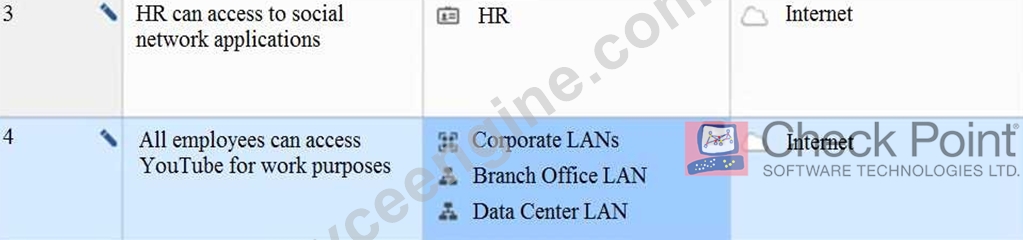
- A. Rules have been edited by the logged in administrator, but the policy has not been published yet.
- B. Another user has currently locked the rules for editing.
- C. The configuration lock is present. Click the pen symbol in order to gain the lock.
- D. Those rules have been published in the current session.
Answer: A
Explanation:
The pen-symbol in the left column means that the rules have been edited by the logged in administrator, but the policy has not been published yet. It indicates that the changes are not yet effective and can be discarded.Policy Editor, Publishing Changes
NEW QUESTION # 97
Fill in the blank: When a policy package is installed, ________ are also distributed to the target installation Security Gateways.
- A. SmartConsole databases
- B. User databases
- C. User and objects databases
- D. Network databases
Answer: C
Explanation:
When a policy package is installed, user and objects databases are also distributed to the target installation Security Gateways14.The user and objects databases contain information about network objects, users, groups, services, VPN domains, and more14. Therefore, the correct answer is A.User and objects databases.
NEW QUESTION # 98
What is the BEST method to deploy Identity Awareness for roaming users?
- A. Use captive portal
- B. Use identity agents
- C. Use Office Mode
- D. Share user identities between gateways
Answer: B
Explanation:
The BEST method to deploy Identity Awareness for roaming users is to useidentity agents, which are software components installed on endpoints that provide user and machine identity information to the Security Gateway45.Identity agents are more secure and reliable than other methods, as they do not require network changes or user interaction4.Office Mode, sharing user identities between gateways, and using captive portal are not methods to deploy Identity Awareness, but rather features or options that can be used with Identity Awareness46.
NEW QUESTION # 99
Which of the following is NOT a tracking log option in R80.x?
- A. Log
- B. Detailed Log
- C. Full Log
- D. Extended Log
Answer: B
Explanation:
Detailed Log is not a valid tracking log option in R80.x3.The tracking log options in R80.x are Log, Full Log, and Extended Log45. Where is 'full log' option in track column,LOGGINGAND MONITORING R80,Logging and Monitoring Administration Guide R80.20
NEW QUESTION # 100
......
Share Latest 156-215.82 DUMP Questions and Answers: https://torrentpdf.vceengine.com/156-215.82-vce-test-engine.html
