

[Feb-2026 Newly Released] Associate-Data-Practitioner Dumps for Google Cloud Platform Certified
Updated Verified Associate-Data-Practitioner dumps Q&As - 100% Pass
NEW QUESTION # 32
Your organization uses scheduled queries to perform transformations on data stored in BigQuery. You discover that one of your scheduled queries has failed. You need to troubleshoot the issue as quickly as possible. What should you do?
- A. Set up a log sink using the gcloud CLI to export BigQuery audit logs to BigQuery. Query those logs to identify the error associated with the failed job ID.
- B. Request access from your admin to the BigQuery information_schema. Query the jobs view with the failed job ID, and analyze error details.
- C. Navigate to the Scheduled queries page in the Google Cloud console. Select the failed job, and analyze the error details.
- D. Navigate to the Logs Explorer page in Cloud Logging. Use filters to find the failed job, and analyze the error details.
Answer: C
NEW QUESTION # 33
Your organization plans to move their on-premises environment to Google Cloud. Your organization's network bandwidth is less than 1 Gbps. You need to move over 500 ## of data to Cloud Storage securely, and only have a few days to move the data. What should you do?
- A. Request multiple Transfer Appliances, copy the data to the appliances, and ship the appliances back to Google Cloud to upload the data to Cloud Storage.
- B. Connect to Google Cloud using Dedicated Interconnect. Use the gcloud storage command to move the data to Cloud Storage.
- C. Connect to Google Cloud using VPN. Use the gcloud storage command to move the data to Cloud Storage.
- D. Connect to Google Cloud using VPN. Use Storage Transfer Service to move the data to Cloud Storage.
Answer: A
Explanation:
UsingTransfer Appliancesis the best solution for securely and efficiently moving over 500 TB of data to Cloud Storage within a limited timeframe, especially with network bandwidth below 1 Gbps. Transfer Appliances are physical devices provided by Google Cloud to securely transfer large amounts of data. After copying the data to the appliances, they are shipped back to Google, where the data is uploaded to Cloud Storage. This approach bypasses bandwidth limitations and ensures the data is migrated quickly and securely.
NEW QUESTION # 34
You are a data analyst at your organization. You have been given a BigQuery dataset that includes customer information. The dataset contains inconsistencies and errors, such as missing values, duplicates, and formatting issues. You need to effectively and quickly clean the dat a. What should you do?
- A. Export the data from BigQuery to CSV files. Resolve the errors using a spreadsheet editor, and re-import the cleaned data into BigQuery.
- B. Use BigQuery's built-in functions to perform data quality transformations.
- C. Use Cloud Data Fusion to create a data pipeline to read the data from BigQuery, perform data quality transformations, and write the clean data back to BigQuery.
- D. Develop a Dataflow pipeline to read the data from BigQuery, perform data quality rules and transformations, and write the cleaned data back to BigQuery.
Answer: B
Explanation:
Using BigQuery's built-in functions is the most effective and efficient way to clean the dataset directly within BigQuery. BigQuery provides powerful SQL capabilities to handle missing values, remove duplicates, and resolve formatting issues without needing to export data or create complex pipelines. This approach minimizes overhead and leverages the scalability of BigQuery for large datasets, making it an ideal solution for quickly addressing data quality issues.
NEW QUESTION # 35
You need to transfer approximately 300 TB of data from your company's on-premises data center to Cloud Storage. You have 100 Mbps internet bandwidth, and the transfer needs to be completed as quickly as possible. What should you do?
- A. Use Cloud Client Libraries to transfer the data over the internet.
- B. Compress the data, upload it to multiple cloud storage providers, and then transfer the data to Cloud Storage.
- C. Use the gcloud storage command to transfer the data over the internet.
- D. Request a Transfer Appliance, copy the data to the appliance, and ship it back to Google.
Answer: D
Explanation:
Comprehensive and Detailed In-Depth Explanation:
Transferring 300 TB over a 100 Mbps connection would take an impractical amount of time (over 300 days at theoretical maximum speed, ignoring real-world constraints like latency). Google Cloud provides the Transfer Appliance for large-scale, time-sensitive transfers.
* Option A: Cloud Client Libraries over the internet would be slow and unreliable for 300 TB due to bandwidth limitations.
* Option B: The gcloud storage command is similarly constrained by internet speed and not designed for such large transfers.
* Option C: Compressing and splitting across multiple providers adds complexity and isn't a Google- supported method for Cloud Storage ingestion.
NEW QUESTION # 36
You are responsible for managing Cloud Storage buckets for a research company. Your company has well- defined data tiering and retention rules. You need to optimize storage costs while achieving your data retention needs. What should you do?
- A. Configure the buckets to use the Archive storage class.
- B. Configure a lifecycle management policy on each bucket to downgrade the storage class and remove objects based on age.
- C. Configure the buckets to use the Standard storage class and enable Object Versioning.
- D. Configure the buckets to use the Autoclass feature.
Answer: B
Explanation:
Configuring alifecycle management policyon each Cloud Storage bucket allows you to automatically transition objects to lower-cost storage classes (such as Nearline, Coldline, or Archive) based on their age or other criteria. Additionally, the policy can automate the removal of objects once they are no longer needed, ensuring compliance with retention rules and optimizing storage costs. This approach aligns well with well- defined data tiering and retention needs, providing cost efficiency and automation.
Extract from Google Documentation: From "Object Lifecycle Management" (https://cloud.google.com
/storage/docs/lifecycle):"Use lifecycle management policies to automatically transition objects to lower-cost storage classes (e.g., Nearline, Coldline) and delete them based on age, optimizing costs according to your specific tiering and retention requirements."
NEW QUESTION # 37
You need to create a new data pipeline. You want a serverless solution that meets the following requirements:
* Data is streamed from Pub/Sub and is processed in real-time.
* Data is transformed before being stored.
* Data is stored in a location that will allow it to be analyzed with SQL using Looker.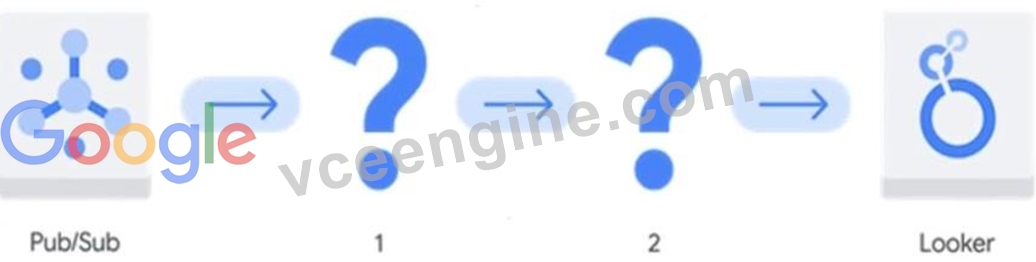
Which Google Cloud services should you recommend for the pipeline?
- A. 1. BigQuery
2. Analytics Hub - B. 1. Dataflow
2. BigQuery - C. 1. Dataproc Serverless
2. Bigtable - D. 1. Cloud Composer
2. Cloud SQL for MySQL
Answer: B
Explanation:
To build a serverless data pipeline that processes data in real-time from Pub/Sub, transforms it, and stores it for SQL-based analysis using Looker, the best solution is to use Dataflow and BigQuery. Dataflow is a fully managed service for real-time data processing and transformation, while BigQuery is a serverless data warehouse that supports SQL-based querying and integrates seamlessly with Looker for data analysis and visualization. This combination meets the requirements for real-time streaming, transformation, and efficient storage for analytical queries.
NEW QUESTION # 38
You are a Looker analyst. You need to add a new field to your Looker report that generates SQL that will run against your company's database. You do not have the Develop permission. What should you do?
- A. Create a new field in the LookML layer, refresh your report, and select your new field from the field picker.
- B. Create a table calculation from the field picker in Looker, and add it to your report.
- C. Create a calculated field using the Add a field option in Looker Studio, and add it to your report.
- D. Create a custom field from the field picker in Looker, and add it to your report.
Answer: D
Explanation:
Creating a custom field from the field picker in Looker allows you to add new fields to your report without requiring the Develop permission. Custom fields are created directly in the Looker UI, enabling you to define calculations or transformations that generate SQL for the database query. This approach is user-friendly and does not require access to the LookML layer, making it the appropriate choice for your situation.
NEW QUESTION # 39
You are building a batch data pipeline to process 100 GB of structured data from multiple sources for daily reporting. You need to transform and standardize the data prior to loading the data to ensure that it is stored in a single dataset. You want to use a low-code solution that can be easily built and managed. What should you do?
- A. Use Cloud Data Fusion to ingest the data, perform data cleaning and transformation, and load the data into Cloud SQL for PostgreSQL.
- B. Use Cloud Storage to store the data. Use Cloud Run functions to perform data cleaning and transformation, and load the data into BigQuery.
- C. Use Cloud Data Fusion to ingest the data, perform data cleaning and transformation, and load the data into BigQuery.
- D. Use Cloud Data Fusion to ingest data and load the data into BigQuery. Use Looker Studio to perform data cleaning and transformation.
Answer: C
Explanation:
Comprehensive and Detailed in Depth Explanation:
Why B is correct:Cloud Data Fusion is a fully managed, cloud-native data integration service for building and managing ETL/ELT data pipelines.
It provides a graphical interface for building pipelines without coding, making it a low-code solution.
Cloud data fusion is perfect for the ingestion, transformation and loading of data into BigQuery.
Why other options are incorrect:A: Looker studio is for visualization, not data transformation.
C: Cloud SQL is a relational database, not ideal for large-scale analytical data.
D: Cloud run is for stateless applications, not batch data processing.
NEW QUESTION # 40
Your organization uses Dataflow pipelines to process real-time financial transactions. You discover that one of your Dataflow jobs has failed. You need to troubleshoot the issue as quickly as possible. What should you do?
- A. Navigate to the Dataflow Jobs page in the Google Cloud console. Use the job logs and worker logs to identify the error.
- B. Use the gcloud CLI tool to retrieve job metrics and logs, and analyze them for errors and performance bottlenecks.
- C. Set up a Cloud Monitoring dashboard to track key Dataflow metrics, such as data throughput, error rates, and resource utilization.
- D. Create a custom script to periodically poll the Dataflow API for job status updates, and send email alerts if any errors are identified.
Answer: A
Explanation:
To troubleshoot a failed Dataflow job as quickly as possible, you should navigate to theDataflow Jobs page in the Google Cloud console. The console provides access to detailed job logs and worker logs, which can help you identify the cause of the failure. The graphical interface also allows you to visualize pipeline stages, monitor performance metrics, and pinpoint where the error occurred, making it the most efficient way to diagnose and resolve the issue promptly.
Extract from Google Documentation: From "Monitoring Dataflow Jobs" (https://cloud.google.com/dataflow
/docs/guides/monitoring-jobs):"To troubleshoot a failed Dataflow job quickly, go to the Dataflow Jobs page in the Google Cloud Console, where you can view job logs and worker logs to identify errors and their root causes."
NEW QUESTION # 41
You are a data analyst working with sensitive customer data in BigQuery. You need to ensure that only authorized personnel within your organization can query this data, while following the principle of least privilege. What should you do?
- A. Enable access control by using IAM roles.
- B. Update dataset privileges by using the SQL GRANT statement.
- C. Encrypt the data by using customer-managed encryption keys (CMEK).
- D. Export the data to Cloud Storage, and use signed URLs to authorize access.
Answer: D
Explanation:
Using IAM roles to enable access control in BigQuery is the best approach to ensure that only authorized personnel can query the sensitive customer data. IAM allows you to define granular permissions at the project, dataset, or table level, ensuring that users have only the access they need in accordance with the principle of least privilege. For example, you can assign roles like roles/bigquery.dataViewer to allow read-only access or roles/bigquery.dataEditor for more advanced permissions. This approach provides centralized and manageable access control, which is critical for protecting sensitive data.
NEW QUESTION # 42
You are using your own data to demonstrate the capabilities of BigQuery to your organization's leadership team. You need to perform a one-time load of the files stored on your local machine into BigQuery using as little effort as possible. What should you do?
- A. Execute the bq load command on your local machine.
- B. Create a Dataproc cluster, copy the files to Cloud Storage, and write an Apache Spark job using the spark-bigquery-connector.
- C. Create a Dataflow job using the Apache Beam FileIO and BigQueryIO connectors with a local runner.
- D. Write and execute a Python script using the BigQuery Storage Write API library.
Answer: A
Explanation:
Comprehensive and Detailed In-Depth Explanation:
A one-time load with minimal effort points to a simple, out-of-the-box tool. The files are local, so the solution must bridge on-premises to BigQuery easily.
* Option A: A Python script with the Storage Write API requires coding, setup (authentication, libraries), and debugging-more effort than necessary for a one-time task.
* Option B: Dataproc with Spark involves cluster creation, file transfer to Cloud Storage, and job scripting-far too complex for a simple load.
* Option C: The bq load command (part of the Google Cloud SDK) is a CLI tool that uploads local files (e.g., CSV, JSON) directly to BigQuery with one command (e.g., bq load --source_format=CSV dataset.
table file.csv). It's pre-built, requires no coding, and leverages existing SDK installation, minimizing effort.
NEW QUESTION # 43
You need to create a data pipeline for a new application. Your application will stream data that needs to be enriched and cleaned. Eventually, the data will be used to train machine learning models. You need to determine the appropriate data manipulation methodology and which Google Cloud services to use in this pipeline. What should you choose?
- A. ELT; Cloud Storage -> Bigtable
- B. ETL; Cloud Data Fusion -> Cloud Storage
- C. ETL; Dataflow -> BigQuery
- D. ELT; Cloud SQL -> Analytics Hub
Answer: C
Explanation:
Comprehensive and Detailed In-Depth Explanation:
Streaming data requiring enrichment and cleaning before ML training suggests an ETL (Extract, Transform, Load) approach, with a focus on real-time processing and a data warehouse for ML.
* Option A: ETL with Dataflow (streaming transformations) and BigQuery (storage/ML training) is Google's recommended pattern for streaming pipelines. Dataflow handles enrichment/cleaning, and BigQuery supports ML model training (BigQuery ML).
* Option B: ETL with Cloud Data Fusion to Cloud Storage is batch-oriented and lacks streaming focus.
Cloud Storage isn't ideal for ML training directly.
* Option C: ELT (load then transform) with Cloud Storage to Bigtable is misaligned-Bigtable is for NoSQL, not ML training or post-load transformation.
NEW QUESTION # 44
You are working with a small dataset in Cloud Storage that needs to be transformed and loaded into BigQuery for analysis. The transformation involves simple filtering and aggregation operations. You want to use the most efficient and cost-effective data manipulation approach. What should you do?
- A. Create a Cloud Data Fusion instance and visually design an ETL pipeline that reads data from Cloud Storage, transforms it using built-in transformations, and loads the results into BigQuery.
- B. Use Dataproc to create an Apache Hadoop cluster, perform the ETL process using Apache Spark, and load the results into BigQuery.
- C. Use Dataflow to perform the ETL process that reads the data from Cloud Storage, transforms it using Apache Beam, and writes the results to BigQuery.
- D. Use BigQuery's SQL capabilities to load the data from Cloud Storage, transform it, and store the results in a new BigQuery table.
Answer: D
Explanation:
Comprehensive and Detailed In-Depth Explanation:
For a small dataset with simple transformations (filtering, aggregation), Google recommends leveraging BigQuery's native SQL capabilities to minimize cost and complexity.
* Option A: Dataproc with Spark is overkill for a small dataset, incurring cluster management costs and setup time.
* Option B: BigQuery can load data directly from Cloud Storage (e.g., CSV, JSON) and perform transformations using SQL in a serverless manner, avoiding additional service costs. This is the most efficient and cost-effective approach.
* Option C: Cloud Data Fusion is suited for complex ETL but adds overhead (instance setup, UI design) unnecessary for simple tasks.
NEW QUESTION # 45
Your organization has highly sensitive data that gets updated once a day and is stored across multiple datasets in BigQuery. You need to provide a new data analyst access to query specific data in BigQuery while preventing access to sensitive dat a. What should you do?
- A. Create a new Google Cloud project, and copy the limited data into a BigQuery table. Grant the data analyst the BigQuery Data Owner IAM role in the new Google Cloud project.
- B. Grant the data analyst the BigQuery Data Viewer IAM role in the Google Cloud project.
- C. Grant the data analyst the BigQuery Job User IAM role in the Google Cloud project.
- D. Create a materialized view with the limited data in a new dataset. Grant the data analyst BigQuery Data Viewer IAM role in the dataset and the BigQuery Job User IAM role in the Google Cloud project.
Answer: D
Explanation:
Creating a materialized view with the limited data in a new dataset and granting the data analyst the BigQuery Data Viewer role on the dataset and the BigQuery Job User role in the project ensures that the analyst can query only the non-sensitive data without access to sensitive datasets. Materialized views allow you to predefine what subset of data is visible, providing a secure and efficient way to control access while maintaining compliance with data governance policies. This approach follows the principle of least privilege while meeting the requirements.
NEW QUESTION # 46
Your company has an on-premises file server with 5 TB of data that needs to be migrated to Google Cloud.
The network operations team has mandated that you can only use up to 250 Mbps of the total available bandwidth for the migration. You need to perform an online migration to Cloud Storage. What should you do?
- A. Use the gcloud storage cp command to copy all files from on-premises to Cloud Storage using the -- daisy-chain option.
- B. Use Storage Transfer Service to configure an agent-based transfer. Set the appropriate bandwidth limit for the agent pool.
- C. Request a Transfer Appliance, copy the data to the appliance, and ship it back to Google Cloud.
- D. Use the gcloud storage cp command to copy all files from on-premises to Cloud Storage using the --no- clobber option.
Answer: B
Explanation:
Comprehensive and Detailed in Depth Explanation:
Why A is correct:Storage Transfer Service with agent-based transfer allows for online migrations and provides the ability to set bandwidth limits.
Agents are installed on-premises and can be configured to respect network constraints.
Why other options are incorrect:B: The --daisy-chain option is not related to bandwidth control.
C: Transfer Appliance is for offline migrations and is not suitable for online transfers with bandwidth constraints.
D: The --no-clobber option prevents overwriting existing files but does not control bandwidth.
NEW QUESTION # 47
Your company has developed a website that allows users to upload and share video files. These files are most frequently accessed and shared when they are initially uploaded. Over time, the files are accessed and shared less frequently, although some old video files may remain very popular. You need to design a storage system that is simple and cost-effective. What should you do?
- A. Create a single-region bucket. Configure a Cloud Scheduler job that runs every 24 hours and changes the storage class based on upload date.
- B. Create a single-region bucket with custom Object Lifecycle Management policies based on upload date.
- C. Create a single-region bucket with Autoclass enabled.
- D. Create a single-region bucket with Archive as the default storage class.
Answer: C
Explanation:
The storage system must balance cost, simplicity, and access patterns: high initial access, decreasing over time, with some files remaining popular. Google Cloud Storage offers tailored options for this:
* Option A: Custom Object Lifecycle Management (OLM) policies (e.g., transition to Nearline after 30 days, Archive after 90 days) are effective but static. They don't adapt to actual usage, so popular old files in Archive would incur high retrieval costs.
* Option B: Autoclass automatically adjusts storage classes (Standard, Nearline, Coldline, Archive) based on object access patterns, not just age. It keeps frequently accessed files in Standard (low latency
/cost for access) and moves inactive ones to cheaper classes, minimizing costs while preserving simplicity. This fits the "some files remain popular" nuance.
* Option C: A Cloud Scheduler job to manually change classes daily is complex (requires scripting, monitoring), error-prone, and less cost-effective than automated solutions like Autoclass or OLM.
NEW QUESTION # 48
You have a Cloud SQL for PostgreSQL database that stores sensitive historical financial data. You need to ensure that the data is uncorrupted and recoverable in the event that the primary region is destroyed. The data is valuable, so you need to prioritize recovery point objective (RPO) over recovery time objective (RTO). You want to recommend a solution that minimizes latency for primary read and write operations. What should you do?
- A. Configure the Cloud SQL for PostgreSQL instance for regional availability (HA). Back up the Cloud SQL for PostgreSQL database hourly to a Cloud Storage bucket in a different region.
- B. Configure the Cloud SQL for PostgreSQL instance for multi-region backup locations.
- C. Configure the Cloud SQL for PostgreSQL instance for regional availability (HA) with synchronous replication to a secondary instance in a different zone.
- D. Configure the Cloud SQL for PostgreSQL instance for regional availability (HA) with asynchronous replication to a secondary instance in a different region.
Answer: B
Explanation:
Comprehensive and Detailed In-Depth Explanation:
The priorities are data integrity, recoverability after a regional disaster, low RPO (minimal data loss), and low latency for primary operations. Let's analyze:
* Option A: Multi-region backups store point-in-time snapshots in a separate region. With automated backups and transaction logs, RPO can be near-zero (e.g., minutes), and recovery is possible post- disaster. Primary operations remain in one zone, minimizing latency.
* Option B: Regional HA (failover to another zone) with hourly cross-region backups protects against zone failures, but hourly backups yield an RPO of up to 1 hour-too high for valuable data. Manual backup management adds overhead.
* Option C: Synchronous replication to another zone ensures zero RPO within a region but doesn't protect against regional loss. Latency increases slightly due to sync writes across zones.
NEW QUESTION # 49
You have a BigQuery dataset containing sales data. This data is actively queried for the first 6 months. After that, the data is not queried but needs to be retained for 3 years for compliance reasons. You need to implement a data management strategy that meets access and compliance requirements, while keeping cost and administrative overhead to a minimum. What should you do?
- A. Use BigQuery long-term storage for the entire dataset. Set up a Cloud Run function to delete the data from BigQuery after 3 years.
- B. Store all data in a single BigQuery table without partitioning or lifecycle policies.
- C. Partition a BigQuery table by month. After 6 months, export the data to Coldline storage. Implement a lifecycle policy to delete the data from Cloud Storage after 3 years.
- D. Set up a scheduled query to export the data to Cloud Storage after 6 months. Write a stored procedure to delete the data from BigQuery after 3 years.
Answer: C
Explanation:
Partitioning the BigQuery table by month allows efficient querying of recent data for the first 6 months, reducing query costs. After 6 months, exporting the data toColdline storageminimizes storage costs for data that is rarely accessed but needs to be retained for compliance. Implementing a lifecycle policy in Cloud Storage automates the deletion of the data after 3 years, ensuring compliance while reducing administrative overhead. This approach balances cost efficiency and compliance requirements effectively.
NEW QUESTION # 50
Your team needs to analyze large datasets stored in BigQuery to identify trends in user behavior. The analysis will involve complex statistical calculations, Python packages, and visualizations. You need to recommend a managed collaborative environment to develop and share the analysis. What should you recommend?
- A. Create a Colab Enterprise notebook and connect the notebook to BigQuery. Share the notebook with your team. Analyze the data and generate visualizations in Colab Enterprise.
- B. Create a statistical model by using BigQuery ML. Share the query with your team. Analyze the data and generate visualizations in Looker Studio.
- C. Connect Google Sheets to BigQuery by using Connected Sheets. Share the Google Sheet with your team. Analyze the data and generate visualizations in Gooqle Sheets.
- D. Create a Looker Studio dashboard and connect the dashboard to BigQuery. Share the dashboard with your team. Analyze the data and generate visualizations in Looker Studio.
Answer: A
Explanation:
Using a Colab Enterprise notebook connected to BigQuery provides a managed, collaborative environment ideal for complex statistical calculations, Python packages, and visualizations. Colab Enterprise supports Python libraries for advanced analytics and offers seamless integration with BigQuery for querying large datasets. It allows teams to collaboratively develop and share analyses while taking advantage of its visualization capabilities. This approach is particularly suitable for tasks involving sophisticated computations and custom visualizations.
NEW QUESTION # 51
You are working on a data pipeline that will validate and clean incoming data before loading it into BigQuery for real-time analysis. You want to ensure that the data validation and cleaning is performed efficiently and can handle high volumes of dat a. What should you do?
- A. Use Dataflow to create a streaming pipeline that includes validation and transformation steps.
- B. Load the raw data into BigQuery using Cloud Storage as a staging area, and use SQL queries in BigQuery to validate and clean the data.
- C. Use Cloud Run functions to trigger data validation and cleaning routines when new data arrives in Cloud Storage.
- D. Write custom scripts in Python to validate and clean the data outside of Google Cloud. Load the cleaned data into BigQuery.
Answer: A
Explanation:
Using Dataflow to create a streaming pipeline that includes validation and transformation steps is the most efficient and scalable approach for real-time analysis. Dataflow is optimized for high-volume data processing and allows you to apply validation and cleaning logic as the data flows through the pipeline. This ensures that only clean, validated data is loaded into BigQuery, supporting real-time analysis while handling high data volumes effectively.
NEW QUESTION # 52
Your organization has a petabyte of application logs stored as Parquet files in Cloud Storage. You need to quickly perform a one-time SQL-based analysis of the files and join them to data that already resides in BigQuery. What should you do?
- A. Create external tables over the files in Cloud Storage, and perform SQL joins to tables in BigQuery to analyze the data.
- B. Use the bq load command to load the Parquet files into BigQuery, and perform SQL joins to analyze the data.
- C. Create a Dataproc cluster, and write a PySpark job to join the data from BigQuery to the files in Cloud Storage.
- D. Launch a Cloud Data Fusion environment, use plugins to connect to BigQuery and Cloud Storage, and use the SQL join operation to analyze the data.
Answer: A
Explanation:
Creating external tables over the Parquet files in Cloud Storage allows you to perform SQL-based analysis and joins with data already in BigQuery without needing to load the files into BigQuery. This approach is efficient for a one-time analysis as it avoids the time and cost associated with loading large volumes of data into BigQuery. External tables provide seamless integration with Cloud Storage, enabling quick and cost-effective analysis of data stored in Parquet format.
NEW QUESTION # 53
Your organization is building a new application on Google Cloud. Several data files will need to be stored in Cloud Storage. Your organization has approved only two specific cloud regions where these data files can reside. You need to determine a Cloud Storage bucket strategy that includes automated high availability.
What should you do?
- A. Create a dual-region bucket, and upload the files to this bucket.
- B. Create a single-region bucket in each of the two regions, and use the gcloud storage command to replicate the data across the buckets in both regions.
- C. Create a multi-region bucket, and upload the files to this bucket.
- D. Create a single-region bucket in each of the two regions, and use Storage Transfer Service to replicate the data across the buckets in both regions.
Answer: A
Explanation:
Comprehensive and Detailed In-Depth Explanation:
The strategy requires storage in two specific regions with automated high availability (HA). Cloud Storage location options dictate the solution:
* Option A: A dual-region bucket (e.g., us-west1 and us-east1) replicates data synchronously across two user-specified regions, ensuring HA without manual intervention. It's fully automated and meets the requirement.
* Option B: Two single-region buckets with gcloud storage replication is manual, not automated, and lacks real-time HA (requires scripting and monitoring).
* Option C: Multi-region buckets (e.g., us) span multiple regions within a geography but don't let you specify exactly two regions, potentially violating the restriction.
NEW QUESTION # 54
You need to create a new data pipeline. You want a serverless solution that meets the following requirements:
* Data is streamed from Pub/Sub and is processed in real-time.
* Data is transformed before being stored.
* Data is stored in a location that will allow it to be analyzed with SQL using Looker.
Which Google Cloud services should you recommend for the pipeline?
- A. 1. BigQuery
2. Analytics Hub - B. 1. Dataflow
2. BigQuery - C. 1. Dataproc Serverless
2. Bigtable - D. 1. Cloud Composer
2. Cloud SQL for MySQL
Answer: B
Explanation:
To build a serverless data pipeline that processes data in real-time from Pub/Sub, transforms it, and stores it for SQL-based analysis using Looker, the best solution is to useDataflowandBigQuery.Dataflowis a fully managed service for real-time data processing and transformation, whileBigQueryis a serverless data warehouse that supports SQL-based querying and integrates seamlessly with Looker for data analysis and visualization. This combination meets the requirements for real-time streaming, transformation, and efficient storage for analytical queries.
NEW QUESTION # 55
......
Google Associate-Data-Practitioner Exam Syllabus Topics:
| Topic | Details |
|---|---|
| Topic 1 |
|
| Topic 2 |
|
| Topic 3 |
|
Latest Associate-Data-Practitioner Exam Dumps Google Exam from Training: https://torrentpdf.vceengine.com/Associate-Data-Practitioner-vce-test-engine.html
