

Get Latest [May-2026] Conduct effective penetration tests using VCEEngine 300-540
Penetration testers simulate 300-540 exam PDF
NEW QUESTION # 14
Diagnosing NFVI errors and events often requires:
- A. Automated monitoring tools
- B. Manual log review
- C. Decreasing security measures
- D. Ignoring alerts
Answer: A
NEW QUESTION # 15
Virus detectors are crucial for:
- A. Increasing the efficiency of network protocols
- B. Detecting and removing malicious software
- C. Enhancing the physical security of network devices
- D. Managing network bandwidth effectively
Answer: B
NEW QUESTION # 16
For infrastructure security, which of the following is NOT typically a focus area?
- A. Enhancing user interface designs
- B. Implementing ACLs for traffic filtering
- C. Encrypting data in transit with MACSEC
- D. Hardening routers to prevent unauthorized access
Answer: A
NEW QUESTION # 17 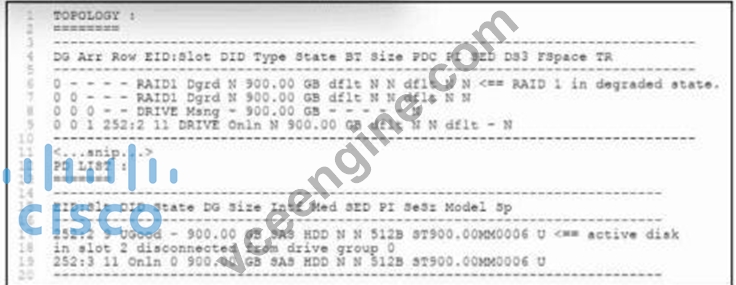
Refer to the exhibit. An engineer is troubleshooting a physical configuration issue in Cisco NFVI. Which two observations should be made? (Choose two.)
- A. Two RAID 1 disks failed.
- B. The node is no longer functional.
- C. The node is still functional.
- D. One RAID 1 disk failed.
- E. The node allows two disks to fail.
Answer: C,D
Explanation:
From the RAID controller output:
* TheRAID1virtual drive is shown as"Dgrd" (degraded)with a note:"RAID 1 in degraded state."
* In thePD LIST, one disk (slot 2) is marked"UGood - active disk in slot 2 disconnected from drive group 0", while the other (slot 3) is"Onln 0"(online and part of drive group 0).
This means:
* In aRAID 1mirror, onlyone diskmay fail while the array remains available.
* Here,one disk has failed/disconnected, the other is still online # the array isdegraded but operational.
Therefore:
* B. One RAID 1 disk failed- correct.
* C. The node is still functional- correct; RAID1 can tolerate a single disk failure.
The other options are incorrect:
* A and Esuggest two disk failures, which is not indicated.
* Dwould be true only if both disks failed; with one disk still online, the node continues to function, though in a degraded state.
NEW QUESTION # 18
The use of pseudowires in DCI solutions is primarily to:
- A. Provide layer 3 connectivity over a layer 2 network
- B. Reduce the overall security of the data being transmitted
- C. Create a physical connection between two points
- D. Simulate a wire-like connection over a packet-switched network
Answer: D
NEW QUESTION # 19
Virus detectors are used to:
- A. Identify and eliminate malware
- B. Monitor network bandwidth
- C. Manage user access
- D. Encrypt traffic
Answer: A
NEW QUESTION # 20
Which of the following is essential for data plane high availability?
- A. Single compute node
- B. Single TOR switch
- C. A single vNIC
- D. Redundant Top of Rack (TOR) switches
Answer: D
NEW QUESTION # 21
Evaluating WAN infrastructure connectivity, one should consider:
- A. The availability and performance requirements of the application
- B. The cost and complexity of IPsec VPNs only
- C. The scalability and flexibility of MPLS/segment routing
- D. The exclusive use of Direct Connect for all scenarios
Answer: A
NEW QUESTION # 22
The primary function of DNS security is to:
- A. Increase website loading speeds
- B. Store data more efficiently
- C. Reduce the cost of internet services
- D. Protect against domain name system attacks
Answer: D
NEW QUESTION # 23 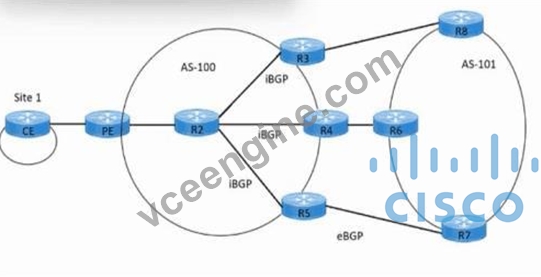
Refer to the exhibit. An engineer working for a private service provider with an employee ID 5207:22:409 must configure iBGP multipath load sharing across the three paths. Which two commands must be run on the PE router? (Choose two.)
- A. router bgp 101
- B. ip load-sharing per-destination
- C. maximum-paths ibgp 3
- D. ip load-sharing ibgp 3
- E. router bgp 100
Answer: C,E
Explanation:
In the diagram, thePE and R2, R3, R4, R5belong toAS 100. The PE router runs BGP processAS 100, so its BGP configuration must start with:
router bgp 100
To performiBGP multipath load sharingacross three equal-cost internal BGP paths, BGP must be instructed to keep and use multiple iBGP paths in the routing table. This is done with:
router bgp 100
maximum-paths ibgp 3
* maximum-paths ibgp 3 tells BGP to install up tothreeiBGP paths to the same prefix, enabling CEF to load-share across those paths.
* router bgp 100 is required because the PE is inAS 100, not 101.
Other options:
* ip load-sharing per-destination affects CEF behavior but does not enable BGP iBGP multipath by itself and is not specific to three iBGP paths.
* ip load-sharing ibgp 3 is not a valid IOS BGP command.
* router bgp 101 would configure the wrong AS and break the iBGP relationships shown in AS-100.
Thus, the correct commands on the PE to achieve iBGP multipath load sharing over the three internal paths are maximum-paths ibgp 3androuter bgp 100, corresponding toA and E.
NEW QUESTION # 24
Which of the following are true about IPsec VPNs? (Choose two)
- A. It encrypts data at the application layer
- B. It is used exclusively within private networks
- C. It is suitable for creating secure connections over the public internet
- D. It provides end-to-end encryption
Answer: C,D
NEW QUESTION # 25
Which of the following are key components of network assurance? (Select two)
- A. Physical network mapping
- B. VNF workloads
- C. Manual network configurations
- D. NFVI MANO
Answer: B,D
NEW QUESTION # 26
IaaS, PaaS, SaaS, and FaaS are all types of cloud services.
Which one provides the most managed service?
- A. FaaS
- B. PaaS
- C. SaaS
- D. IaaS
Answer: C
NEW QUESTION # 27
Cloud infrastructure monitoring can be automated through the use of:
- A. Cloud agents
- B. Manual system checks
- C. Physical network adjustments
- D. Decreasing telemetry data
Answer: A
NEW QUESTION # 28
What is the purpose of VNF data plane redundancy?
- A. To decrease network performance
- B. To ensure data plane resiliency through placement and network resiliency
- C. To simplify network management
- D. To increase the cost of infrastructure
Answer: B
NEW QUESTION # 29 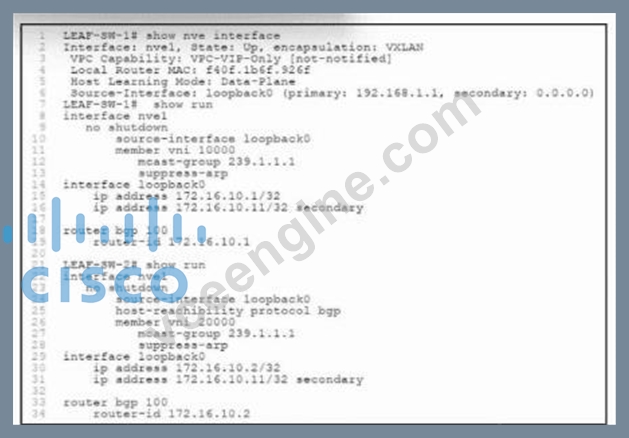
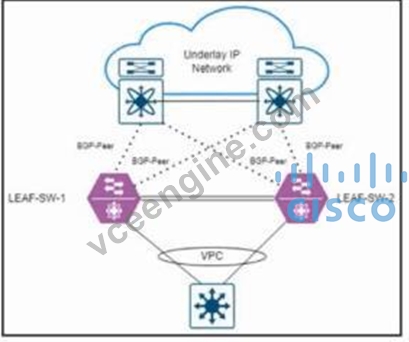
Refer to the exhibit. An engineer is troubleshooting an issue where switch LEAF-SW-1 and switch LEAF- SW-2 receive corrupted forwarding and learning information about each other. LEAF-SW-1 and LEAF-SW-2 are configured with BGP EVPN VTEP. Which action resolves the issue?
- A. On each switch, ensure the same BGP router ID is configured.
- B. On each switch, run the delete suppress-arp command against interface nve1.
- C. On LEAF-SW-1, run the host-reachability protocol bgp command against interface nve1.
- D. On each switch, configure a different secondary IP address against interface loopback0.
Answer: C
Explanation:
In a VXLAN BGP EVPN fabric, each VTEP (NVE interface) must useBGP EVPN as the host-reachability protocolso that MAC/IP information and VTEP reachability are exchanged through the control plane.
From the exhibit:
* LEAF-SW-1 - interface nve1
* source-interface loopback0
* No host-reachability protocol bgp
* Host Learning Mode: Data-Plane in show nve interface
* LEAF-SW-2 - interface nve1
* source-interface loopback0
* host-reachability protocol bgp configured
This mismatch causes one VTEP to rely ondata-plane flood-and-learn, while the other usesEVPN BGP control-plane learning, leading to inconsistent and "corrupted" MAC/IP and ARP/ND information between the leaf switches.
The fix is to configure LEAF-SW-1 to also use BGP for host reachability:
interface nve1
host-reachability protocol bgp
Options B and D are incorrect because anycast VTEP designs intentionally share the sameprimaryloopback IP while usingdifferent secondary IPsandunique BGP router IDs. Option A (removing suppress-arp) does not correct the control-plane mismatch.
Therefore, enabling host-reachability protocol bgp on LEAF-SW-1 (OptionC) resolves the issue.
NEW QUESTION # 30
......
Tested Material Used To 300-540 Test Engine: https://torrentpdf.vceengine.com/300-540-vce-test-engine.html
