

Mar-2026 Latest VCEEngine 1z1-809 Exam Dumps with PDF and Exam Engine Free Updated Today!
Following are some new 1z1-809 Real Exam Questions!
NEW QUESTION # 93
Given the definition of the Bookclass: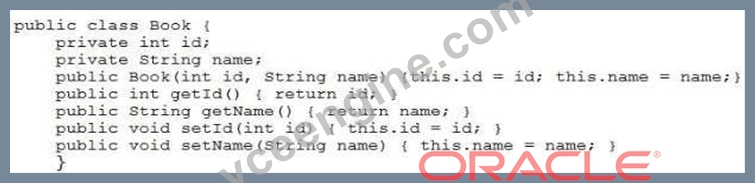
Which statement is true about the Bookclass?
- A. It demonstrates encapsulation.
- B. It is defined using the factory design pattern.
- C. It is defined using the singleton design pattern.
- D. It demonstrates polymorphism.
- E. It is an immutable class.
Answer: A
NEW QUESTION # 94
Given the code fragment:
List<String> colors = Arrays.asList("red", "green", "yellow");
Predicate<String> test = n - > {
System.out.println("Searching...");
return n.contains("red");
};
colors.stream()
.filter(c -> c.length() > 3)
.allMatch(test);
What is the result?
Searching...
- A. A compilation error occurs.
- B. Searching...
Searching... - C. Searching...
Searching... - D. Searching...
Answer: D
NEW QUESTION # 95
Given the code fragments:
class Employee {
Optional<Address> address;
Employee (Optional<Address> address) {
this.address = address;
}
public Optional<Address> getAddress() { return address; }
}
class Address {
String city = "New York";
public String getCity { return city: }
public String toString() {
return city;
}
}
and
Address address = null;
Optional<Address> addrs1 = Optional.ofNullable (address);
Employee e1 = new Employee (addrs1);
String eAddress = (addrs1.isPresent()) ? addrs1.get().getCity() : "City Not
available";
What is the result?
- A. null
- B. A NoSuchElementException is thrown at run time.
- C. New York
- D. City Not available
Answer: A
NEW QUESTION # 96
Which two statements are true for a two-dimensional array of primitive data type?
- A. All methods of the class object may be invoked on the two-dimensional array.
- B. It cannot contain elements of different types.
- C. At the declaration time, the number of elements of the array in each dimension must be specified.
- D. The length of each dimension must be the same.
Answer: A,B
NEW QUESTION # 97
Given the code fragment:
Path file = Paths.get ("courses.txt");
// line n1
Assume the courses.txtis accessible.
Which code fragment can be inserted at line n1to enable the code to print the content of the courses.txtfile?
- A. Stream<String> fc = Files.readAllLines (file);
fc.forEach (s - > System.out.println(s)); - B. List<String> fc = Files.list(file);
fc.stream().forEach (s - > System.out.println(s)); - C. List<String> fc = readAllLines(file);
fc.stream().forEach (s - > System.out.println(s)); - D. Stream<String> fc = Files.lines (file);
fc.forEach (s - > System.out.println(s));
Answer: A
NEW QUESTION # 98
Given:
class CheckClass {
public static int checkValue (String s1, String s2) {
return s1 length() - s2.length();
}
}
and the code fragment:
String[] strArray = new String [] {"Tiger", "Rat", "Cat", "Lion"}
//line n1
for (String s : strArray) {
System.out.print (s + " ");
}
Which code fragment should be inserted at line n1 to enable the code to print Rat Cat Lion Tiger?
- A. Arrays.sort(strArray, (CheckClass : : new) : : checkValue);
- B. Arrays.sort(strArray, (CheckClass : : new).checkValue);
- C. Arrays.sort(strArray, CheckClass : : checkValue);
- D. Arrays.sort(strArray, CheckClass : : new : : checkValue);
Answer: C
NEW QUESTION # 99
Given the code fragment: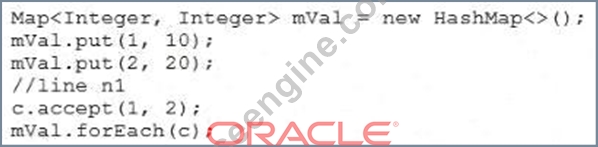
Which statement can be inserted into line n1 to print 1,2; 1,10; 2,20;?
- A. BiConsumer<Integer,Integer> c = (i, j) -> {System.out.print (i + "," + j+ "; ");};
- B. BiConsumer<Integer, Integer, String> c = (i, j) -> {System.out.print (i + "," + j+ "; ")};
- C. BiFunction<Integer, Integer, String> c = (i, j) -> {System.out.print (i + "," + j+ "; ")};
- D. BiConsumer<Integer, Integer, Integer> c = (i, j) -> {System.out.print (i + "," + j+ "; ");};
Answer: C
Explanation:
References:
NEW QUESTION # 100
Given the code fragment:
Which code fragment prints red: blue: sma11: medium: ?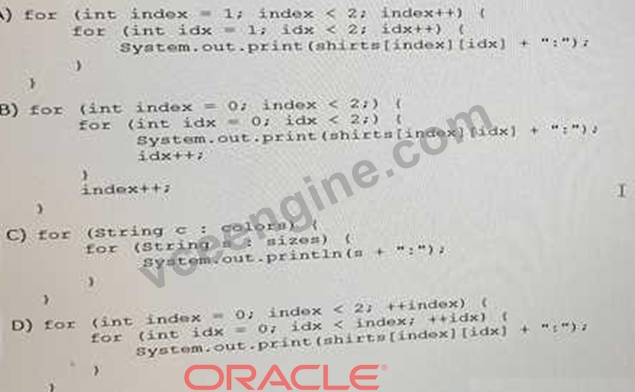
- A. Option A
- B. Option D
- C. Option C
- D. Option B
Answer: D
NEW QUESTION # 101
Given the code fragments:
class ThreadRunner implements Runnable {
public void run () { System.out.print ("Runnable") ; }
}
class ThreadCaller implements Callable {
Public String call () throws Exception {return "Callable"; )
}
and
ExecutorService es = Executors.newCachedThreadPool ();
Runnable r1 = new ThreadRunner ();
Callable c1 = new ThreadCaller ();
// line n1
es.shutdown();
Which code fragment can be inserted at line n1 to start r1 and c1 threads?
- A. es.submit(r1);Future<String> f1 = es.submit (c1);
- B. Future<String> f1 = (Future<String>) es.execute(r1);Future<String> f2 = (Future<String>) es.execute(c1);
- C. es.execute (r1);Future<String> f1 = es.execute (c1) ;
- D. Future<String> f1 = (Future<String>) es.submit (r1);es.execute (c1);
Answer: A
NEW QUESTION # 102
Given the code fragment:
String str = "Java is a programming language"; ToIntFunction<String> indexVal = str: : indexOf; //line n1 int x = indexVal.applyAsInt("Java");//line n2 System.out.println(x);
What is the result?
- A. A compilation error occurs at line n1.
- B. 0
- C. 1
- D. A compilation error occurs at line n2.
Answer: C
NEW QUESTION # 103
Given:
public class Emp {
String fName;
String lName;
public Emp (String fn, String ln) {
fName = fn;
lName = ln;
}
public String getfName() { return fName; }
public String getlName() { return lName; }
}
and the code fragment:
List<Emp> emp = Arrays.asList (
new Emp ("John", "Smith"),
new Emp ("Peter", "Sam"),
new Emp ("Thomas", "Wale"));
emp.stream()
//line n1
.collect(Collectors.toList());
Which code fragment, when inserted at line n1, sorts the employees list in descending order of fNameand then ascending order of lName?
.sorted (Comparator.comparing(Emp::getfName).reserved().thenComparing
- A. .map(Emp::getfName).sorted(Comparator.reserveOrder())
- B. (Emp::getlName).reserved
- C. (Emp::getlName))
.sorted (Comparator.comparing(Emp::getfName).thenComparing(Emp::getlName)) - D. .map(Emp::getfName).sorted(Comparator.reserveOrder().map
Answer: A
NEW QUESTION # 104
Given the code fragment:
Which three code fragments are valid at line n1?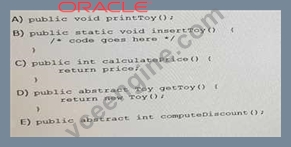
- A. Option A
- B. Option C
- C. Option D
- D. Option B
- E. Option E
Answer: B,D,E
NEW QUESTION # 105
Given: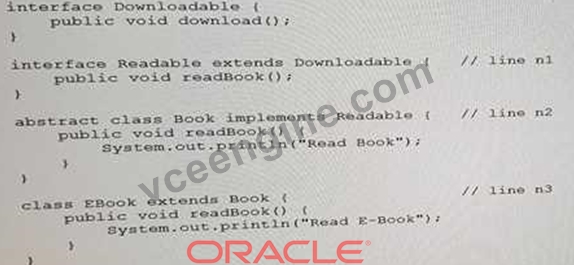
And given the code fragment:
What is the result?
- A. Compilation fails at line n1.
- B. Compilation fails at line n3.
- C. Read Book
- D. Compilation fails at line n2.
- E. Read E-Book
Answer: B
NEW QUESTION # 106
Given the content of the employee.txt file:
Every worker is a master.
Given that the employee.txt file is accessible and the file allemp.txt does NOT exist, and the code fragment: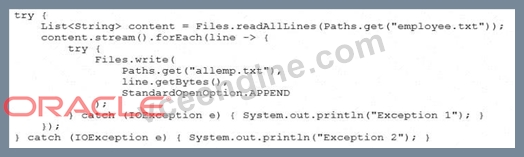
What is the result?
- A. Exception 1
- B. allemp.txt is created and the content of employee.txt is copied to it.
- C. Exception 2
- D. The program executes, does NOT affect the system, and produces NO output.
Answer: A
NEW QUESTION # 107
Given the code fragments:
class ThreadRunner implements Runnable {
public void run () { System.out.print ("Runnable") ; }
}
class ThreadCaller implements Callable {
Public String call () throws Exception {return "Callable"; )
}
and
ExecutorService es = Executors.newCachedThreadPool ();
Runnable r1 = new ThreadRunner ();
Callable c1 = new ThreadCaller ();
// line n1
es.shutdown();
Which code fragment can be inserted at line n1to start r1and c1 threads?
Future<String> f1 = (Future<String>) es.submit (r1);
- A. Future<String> f2 = (Future<String>) es.execute(c1);
es.submit(r1); - B. Future<String> f1 = es.submit (c1);
- C. Future<String> f1 = es.execute (c1) ;
Future<String> f1 = (Future<String>) es.execute(r1); - D. es.execute (c1);
es.execute (r1);
Answer: B
NEW QUESTION # 108
Given the code fragment:
Which code fragment, when inserted at line 7, enables printing 100?
- A. ToIntFunction funRef = e -> e + 10;int result = funRef.apply (value);
- B. IntFunction funRef = e -> e + 10;Integer result = funRef.apply (10);
- C. Function<Integer> funRef = e -> e + 10;Integer result = funRef.apply(value);
- D. ToIntFunction<Integer> funRef = e -> e + 10;int result = funRef.applyAsInt (value);
Answer: C
NEW QUESTION # 109
......
Resources From:
- 2026 Latest VCEEngine 1z1-809 Exam Dumps (PDF & Exam Engine) Free Share: https://torrentpdf.vceengine.com/1z1-809-vce-test-engine.html
Free Resources from VCEEngine, We Devoted to Helping You 100% Pass All Exams!
