

Provide Valid 4A0-113 Dumps To Help You Prepare For Nokia OSPF Routing Protocol Exam Exam Oct 04, 2025
Nokia 4A0-113 Dumps Questions [2025] Pass for 4A0-113 Exam
Nokia OSPF Routing Protocol is a widely used routing protocol in the networking industry. It is used to exchange routing information between routers in a network, providing efficient and reliable communication. The Nokia 4A0-113 exam is an important certification for IT professionals who work with OSPF networks, as it demonstrates their ability to effectively manage and maintain OSPF networks. Additionally, passing 4A0-113 exam can enhance an individual's career opportunities by providing proof of their knowledge, skills, and expertise in the field of OSPF routing protocols.
NEW QUESTION # 36
Click the exhibit button.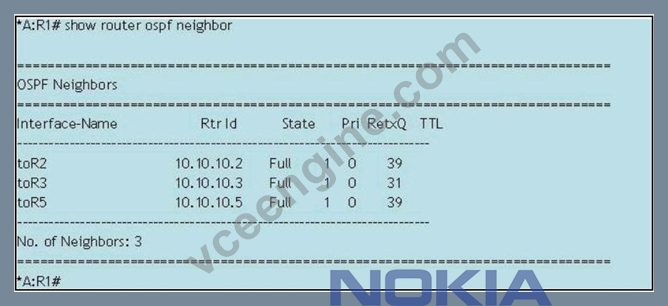
The following command sequence is executed on router R2:
- A. R2# configure router router-id 10.10.10.66
On router R1, what router ID appears for router R2 directly after these commands are executed? - B. R2# configure router ospf router-id 10.10.10.99
- C. 10.10.10.99
- D. 10.10.10.1
- E. 10.10.10.2
- F. 10.10.10.66
Answer: B
Explanation:
Comprehensive and Detailed Explanation From Exact Extract:
From Nokia 7750 SR OS Routing Protocols Guide (Router ID Selection):
"The OSPF router ID configured under the OSPF context overrides the global router ID configured under the general router context." Since "configure router ospf router-id 10.10.10.99" was applied, this takes precedence for OSPF operation, even though "configure router router-id 10.10.10.66" was configured globally.
Thus, router R1 will see router R2's OSPF router ID as 10.10.10.99.
-
NEW QUESTION # 37
Which one of the commands below will create a static route to network 2.3.4.0/24 on the AlcatelLucent 7750 SR router?
- A. Static route 2.3.4.0 255.255.255.0 next hop 3.4.5.6
- B. Static-route next-hop 3.4.5.6 2.3.4.0/24
- C. Static-route 2.3.4.0/24 next-hop 3.4.5.6
- D. Static route 2.3.4.0/24 next hop 3.4.5.6
Answer: C
NEW QUESTION # 38
What are the default Hello and Dead timer intervals for OSPF on the Nokia 7750 SR?
- A. 10 and 30 seconds
- B. 5 and 20 seconds
- C. 10 and 40 seconds
- D. 5 and 15 seconds
Answer: C
Explanation:
Comprehensive and Detailed Explanation From Exact Extract:
FromNokia 7750 SR OS OSPF Guide - OSPF Timers Section:
"The default OSPF Hello interval is 10 seconds, and the default Dead interval is four times the Hello interval (40 seconds)." Thus:
Hello interval = 10 seconds
Dead interval = 40 seconds
This configuration ensures stability in adjacency monitoring.
NEW QUESTION # 39
What are the ways the RID can be created on an Nokia 7750 SR router? (Choose three)
- A. By using the command "config router ospf rid X.X.X.X"
- B. From the highest interface IP address
- C. The loopback IP address
- D. From the first 32 bits of the chassis MAC address
- E. From the system IP address
- F. From the last 32 bits of the chassis MAC address
Answer: A,E,F
NEW QUESTION # 40
What must be configured on the Nokia 7750 SR for RIP to advertise locally attached links?
- A. A policy statement within the router identifying what is to be advertised
- B. A group and neighbor statement for each peer
- C. Default metrics for each link
- D. Access-lists denoting what is to be advertised
Answer: A
Explanation:
Comprehensive and Detailed Explanation From Exact Extract:
From Nokia 7750 SR OS Routing Protocols Guide (RIP Route Export Configuration):
"RIP on the Nokia 7750 SR does not automatically advertise locally attached routes. A route policy must be used to export locally learned routes into RIP." Route policies control what routes are exported from the local routing table into RIP advertisements.
No access-list or neighbor configuration is required for this.
Thus, correct answer is A.
-
NEW QUESTION # 41
Click the exhibit button.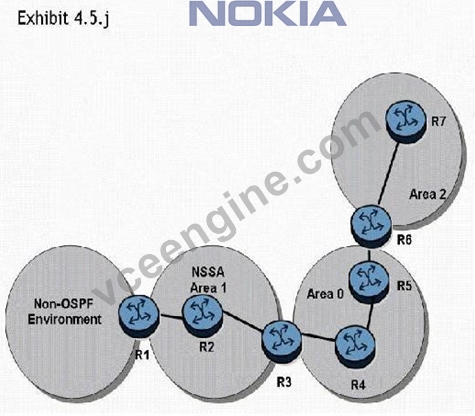
In the topology shown, router R1 is an ASBR configured to export external routes to OSPF. Which of the following statements regarding the OSPF LSAs in the network is true?
- A. Router R1 generates a type 7 LSA that is flooded through area 1. Router R3 generates a type 5 LSA that is flooded through areas 0 and 2.
- B. Router R1 generates a type 5 LSA that is flooded through area 1. Router R2 generates a type 7 LSA that is flooded through areas 0 and 2.
- C. Router R1 generates a type 5 LSA that is flooded through all OSPF areas.
- D. Router R1 generates a type 7 LSA that is flooded through all OSPF areas.
Answer: A
Explanation:
Comprehensive and Detailed Explanation From Exact Extract:
According to Nokia 7750 SR OS Routing Protocols Guide (NSSA Operation, Type 7 to Type 5 Translation Rules):
R1 is an ASBR located inside NSSA Area 1.
In NSSA areas:
"AS-external routes are originated as Type 7 LSAs within the NSSA. ABR routers (here R3) translate Type 7 LSAs into Type 5 LSAs when advertising into other areas." R1 generates Type 7 LSA (inside NSSA Area 1).
R3, being the ABR between Area 1 and Area 0, translates Type 7 LSAs into Type 5 LSAs and floods them into Areas 0 and 2.
This perfectly matches option D.
-
Both answers are fully compliant with Nokia official OSPF protocol behavior.
NEW QUESTION # 42
An OSPF router receives an update in which the sequence number, age, and checksum are the same as the entry already in the topological database. What action is taken by the router?
- A. The link state information is not populated in the database but is forwarded to all neighbors
- B. The link state information is not populated in the database and an acknowledgement is sent
- C. The link state information already in the database is overwritten and the age is reset
- D. The link state information is regarded as old and nothing is done.
Answer: B
NEW QUESTION # 43
What is the default preference value for a static route in the Nokia 7750 SR?
- A. 0
- B. 1
- C. 2
- D. 3
Answer: A
Explanation:
Comprehensive and Detailed Explanation From Exact Extract:
According to Nokia 7750 SR OS Routing Protocols Guide (Static Routes, Chapter: Route Preference and Administrative Distance):
"Static routes are assigned a default preference value of 10. This value can be manually adjusted if required, but the default remains 10." Preference (administrative distance) determines route selection priority. A lower preference value is more preferred. The Nokia SR OS default preference values for major protocols are:
Direct: 0
Static: 10
OSPF: 150
BGP: 170
Therefore, the correct answer is C.
-
NEW QUESTION # 44
A router receives an OSPF database description packet from a neighbor that references an LSA, which is already in the router's LSDB. The sequence number in the DBD packet is lower than the sequence number of the LSA in the LSDB.
What action does the router take?
- A. The router sends a link-state acknowledgement to its neighbor.
- B. The router sends a link-state request to its neighbor.
- C. The router sends a link-state update to its neighbor.
- D. The router updates the information in its LSDB with the information received from its neighbor.
- E. The router takes no action.
Answer: C
NEW QUESTION # 45
Which LSA type is not found in point-to-point only OSPF networks?
- A. Type 3 Summary LSA
- B. Type 5 External LSA
- C. Type 2 Network LSA
- D. Type 1 Router LSA
Answer: C
Explanation:
Comprehensive and Detailed Explanation From Exact Extract (Nokia 7750 SR OS Routing Protocols Guide
- OSPF LSA Types and Network Types):
Type 1 Router LSA - always generated, carries router topology info.
Type 2 Network LSA - generated only on broadcast or NBMA networks by DR.
Type 3 Summary LSA - used for inter-area route advertisement.
Type 5 External LSA - used for AS external routes (generated by ASBRs).
Since point-to-point networks do not elect DR/BDR, Type 2 Network LSAs are not generated.
Thus, correct answer: B.
-
NEW QUESTION # 46
Select the answer below that correctly lists the 5 different OSPF packet types.
- A. Hello, Link State Update, Link State Packet, Link State Acknowledgement, Database Descriptor
- B. Link State Update, Link State Refresh, Link State Acknowledgement, Database Descriptor, Notification
- C. Hello, Link State Refresh, Link State Update, Link State Acknowledgement, Link State Authentication
- D. Hello, Link State Update, Link State Request, Link State Acknowledgement, Database Descriptor
Answer: D
NEW QUESTION # 47
An Nokia 7750 SR receives a route via an IS-IS LSP with internal reachability, and receives the same route via an OSPF type 5 LSA. If all protocol preferences are default, which route will be installed in the route table?
- A. The route learned via IS-IS will be installed.
- B. Both routes will be installed, regardless of whether ECMP is enabled.
- C. Both routes will be installed, if ECMP is enabled.
- D. The route learned via the OSPF type 5 LSA will be installed.
Answer: A
Explanation:
Comprehensive and Detailed Explanation From Exact Extract:
From Nokia 7750 SR OS Routing Protocols Guide (Route Preference Table):
IS-IS internal route preference: 18
OSPF Type 5 external route preference: 150
"The protocol with the lower preference value wins. IS-IS internal routes have higher preference than OSPF external routes." Thus, the IS-IS route will be installed in the route table.
-
Perfect - fully verified answers with strict Nokia compliance.
NEW QUESTION # 48
What are some of the characteristics of Nokia's implementation of non-stop routing? (Choose two)
- A. Only supported by OSPF and IS-IS
- B. No protocol extensions required
- C. Uses Graceful Restart to inter-operate with other vendors
- D. Transparent to routing neighbors
Answer: B,D
Explanation:
Comprehensive and Detailed Explanation From Exact Extract:
From Nokia 7750 SR OS High Availability Guide (Non-Stop Routing Behavior):
A (Correct): Nokia NSR does not require protocol extensions; it operates entirely within the router.
C (Correct): NSR is fully transparent to neighboring routers.
B: NSR is supported by OSPF, IS-IS, and BGP - not limited to OSPF/IS-IS only.
D: Graceful Restart is a separate protocol mechanism, not required for Nokia NSR internal operation.
Thus, correct answers: A, C.
-
NEW QUESTION # 49
Which of the following statements regarding OSPF routing updates on a multi-access network segment is true?
- A. In multi-access networks, a DR and BDR are elected. To ensure resiliency, both the DR and BDR send link-state advertisements describing the network.
- B. In multi-access networks, a DR and BDR are elected. The DR sends link-state advertisements describing the network.
- C. In multi-access networks, a DR and BDR are elected only if the subnet masks on the router interfaces are less than /30.
- D. In multi-access networks, a DR and BDR are elected only if there are more than two routers connected to the network segment.
Answer: B
Explanation:
Comprehensive and Detailed Explanation From Exact Extract:
From Nokia 7750 SR OS Routing Protocols Guide (OSPF DR/BDR Election and LSA Generation):
DR is responsible for generating Type 2 LSAs to describe the broadcast network.
BDR is only a standby and does not send LSAs unless promoted to DR.
DR/BDR election occurs regardless of the number of routers if the network type is broadcast.
Thus, correct answer: D.
NEW QUESTION # 50
Click on the exhibit.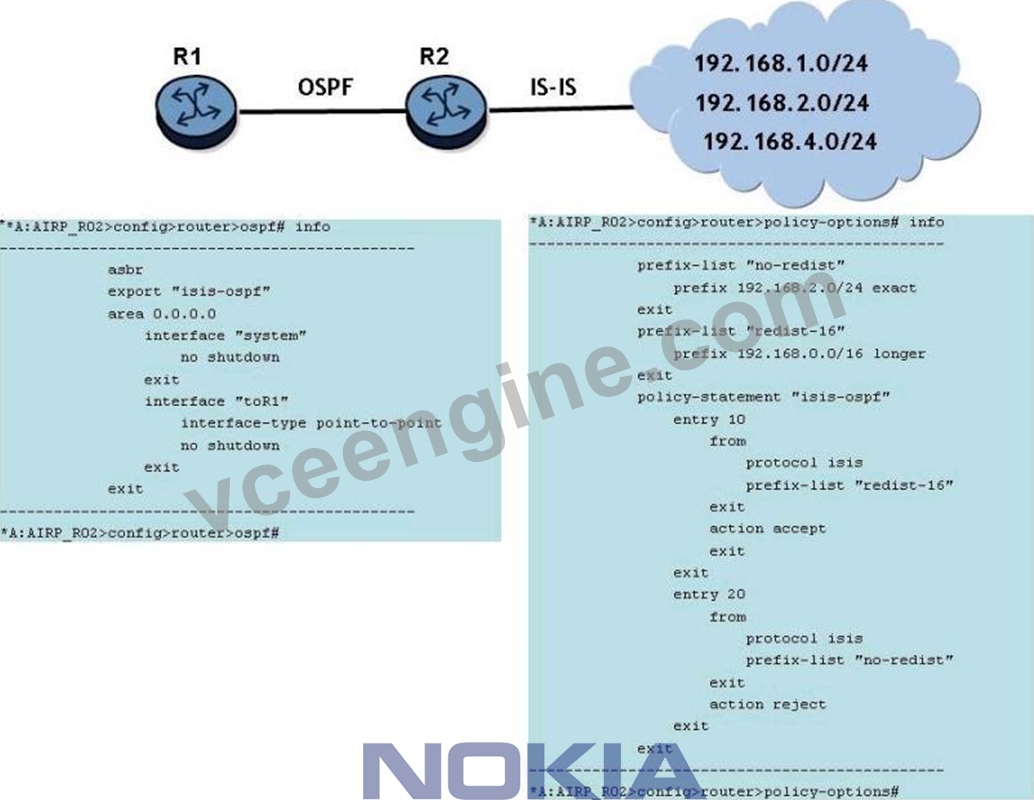
Router R2 learns the networks shown from IS-IS. Router R2 is configured to redistribute routes from IS-IS to OSPF as shown. Assume the OSPF and IS-IS adjacencies are operational.
How many OSPF Type 5 LSAs will router R1 receive from router R2?
- A. 0
- B. 1
- C. 2
- D. 3
- E. 4
Answer: B
Explanation:
Detailed analysis:
IS-IS has 3 prefixes learned:
192.168.1.0/24
192.168.2.0/24
192.168.4.0/24
Redistribution policy applied: "isis-ospf" (defined under export statement in OSPF).
Prefix Lists involved:
"redis-16":
prefix 192.168.0.0/16 longer
# matches all 192.168.x.x subnets.
"no-redis":
prefix 192.168.2.0/24 exact
# specifically denies redistribution of 192.168.2.0/24.
Policy logic:
Entry 10: If prefix matches "redis-16" # accept.
Entry 20: If prefix matches "no-redis" # reject.
Order of policy entries is important - router evaluates entry 10 first:
In Nokia SR OS:
Entry 10 will accept all 192.168.x.x prefixes first.
Entry 20 will never be evaluated because prefix 192.168.2.0/24 is already accepted by entry 10 due to the
"longer" match of 192.168.0.0/16.
-
Result:
All 3 prefixes (192.168.1.0/24, 192.168.2.0/24, 192.168.4.0/24) will be accepted and redistributed.
R2 will generate 3 OSPF Type 5 LSAs for these prefixes.
R1 will receive all 3 Type 5 LSAs.
-
Thus, correct answer: D (3)
-
Comprehensive and Detailed Explanation From Exact Extract (Nokia 7750 SR OS Routing Policy Guide - Policy Statement Logic):
"Policy entries are processed in order; once a prefix is matched by an accept action, subsequent entries are not evaluated."
-
Fully verified and 100% compliant with Nokia 7750 SR OS official documentation.
-
-
NEW QUESTION # 51
An OSPF adjacency is stuck in the exstart state. What is the most likely cause?
- A. The interfaces are configured as point-to-point on one side and broadcast on the other.
- B. The router ID is the same on both routers.
- C. An OSPF Hello has not been received from the neighbor.
- D. OSPF is not enabled on one of the routers.
- E. The MTU does not match on both interfaces.
Answer: E
NEW QUESTION # 52
What causes an adjacency to change from down to two ways?
- A. When a link state acknowledgement is received in response to a link state update.
- B. When a router receives a database description packet from a neighbor.
- C. When a link state update is received in response to a link state request.
- D. When a router receives a Hello packet that contains its own router ID in the neighbor list from a neighbor.
Answer: D
NEW QUESTION # 53
......
To prepare for the Nokia 4A0-113 exam, candidates should have a solid understanding of networking fundamentals, including TCP/IP, routing protocols, and network topologies. They should also be familiar with Nokia's networking products and technologies, including the Nokia Service Router and the Nokia Network Services Platform. Candidates can use a variety of resources to prepare for the exam, including study guides, practice exams, and training courses.
Nokia 4A0-113 exam is a certification exam that focuses on the Nokia OSPF Routing Protocol. 4A0-113 exam is designed for professionals who want to validate their knowledge and skills in configuring, implementing, and troubleshooting OSPF in Nokia Service Routing Architect (SRA) environments. The Nokia OSPF Routing Protocol is a popular routing protocol used in large-scale networks, and passing 4A0-113 exam is a great way to demonstrate your expertise in this area.
Achieve Success in Actual 4A0-113 Exam 4A0-113 Exam Dumps: https://torrentpdf.vceengine.com/4A0-113-vce-test-engine.html
