

Use Real B2B-Solution-Architect - 100% Cover Real Exam Questions [May-2026]
Dumps Brief Outline Of The B2B-Solution-Architect Exam - VCEEngine
NEW QUESTION # 52
Universal Containers (UC) has acquired four companies and is looking to manage revenue across all mergers' territories seamlessly. UC wants to drive major business decision and selling strategies based on an efficient, complete, real-time view of team forecasts across territories from Salesforce. A sales user can be part of multiple territories and is usually working on multiple opportunities at a time.
Which technical consideration should a Solution Architect make when designing collaborative forecasting?
- A. Forecast category names can be customized by submitting a Salesforce Support case.
- B. Important details should be tracked at the opportunity line level.
- C. If the sales user has many territories assigned to them, it can impact the performance of the forecast.
- D. Archiving a territory model does not impact forecasts, quotas, and adjustments for all territories in the model.
Answer: C
Explanation:
In designing collaborative forecasting, especially in a complex organization like UC with multiple acquisitions and territories, it's crucial to consider the system's performance. When a sales user is assigned to multiple territories, and they work on numerous opportunities, it can significantly impact the system's ability to generate accurate and timely forecasts. Salesforce's own documentation on collaborative forecasting emphasizes the need to carefully manage territory assignments and forecast calculations to maintain system performance and forecast accuracy.
Reference to these considerations can be found in Salesforce's Release Notes and Administrator Guide, where Salesforce discusses best practices for managing territories and forecasts in complex sales environments.
https://help.salesforce.com/s/articleView?id=000199046&language=en_US&type=1
NEW QUESTION # 53
Northern Trail Outfitters (NTO) is in the middle of the buildout of Marketing Cloud Account Engagement and Sales Cloud. NTO has multiple business units, and each business unit has different access to lead and contactrecords. NTO wants to see how marketing data Sharing Rules are working across different business units to ensure that different business units can only see lead or contact records for their business unit.
What should a Solution Architect demo to the Marketing team to show that the different business units are connected correctly?
- A. Send test emails from Marketing CloudAccount Engagement to the same Iist of leads and contacts to show each lead or contact receiving emails from the various business units.
- B. Create a dynamic list m multiple business units with the same rules, and show the total leads and contacts m the list per business unit.
- C. It's not possible to have sandboxes with Marketing Cloud Account Engagement, and the Solution Architect will need todemo this with a Salesforce Sandbox fixed to a live Marketing Cloud Account Engagement environment.
- D. Create a report in 626 Marketing Analytics to show the different business units and the total leads and contacts in each business unit.
Answer: B
Explanation:
To demonstrate that different business units can only see lead or contact records for their business unit, a Solution Architect can create a dynamic list that applies the same rules to multiple business units. The dynamic list will show the total leads and contacts in the list for each business unit, demonstrating that the data sharing rules are working correctly.
To demonstrate that Marketing Cloud Account Engagement (formerly Pardot) is correctly connected with Sales Cloud across different business units, creating dynamic lists with identical criteria in each business unit and comparing the total leads and contacts can effectively showcase proper segmentation and access control. This approach allows the Solution Architect to visually represent how marketing data and activities are appropriately partitioned and managed across the business units, ensuring that leads and contacts are only accessible by the relevant teams, in line with Salesforce's best practices for managing data in multi-business unit environments.
NEW QUESTION # 54
Universal Containers (UC) is concerned about potential data storage issues in Salesforce due to the Invoice, Order, and Inventory data that would be flowing infrom various on-premise legacy CRM and ERP applications. UC would like to view and occasionally report on this data on-demand for day-to-day operational processes and would prefer not to store the data in Salesforce due to data residency requirements.
Which recommendation should the Solution Architect make to meet this requirement?
- A. Push the data into Salesforce and implement an archival strategy.
- B. Write custom Apex code to retrieve the data in real time from external systems.
- C. Use Salesforce Orchestrator with MuleSoft to retrieve the data when it is needed.
- D. Re-architect the implementation using Salesforce Connect and external objects.
Answer: D
Explanation:
External objects are similar to custom objects but they map to data that's stored outside Salesforce. Salesforce Connect uses external data sources to access data that's stored outside your Salesforce organization1. This way, UC can comply with data residency requirements and avoid datastorage issues.
Salesforce Connect allows Salesforce to seamlessly integrate with data that is external to the Salesforce platform, which in this case is the legacy CRM and ERP applications. External objects provide a real-time view of this external data,allowing UC to view and report on it as if it were stored natively in Salesforce, without actually storing it in Salesforce.
Reference: Salesforce B2B Commerce Implementation Guide - Salesforce Connect for External Data Salesforce Connect allows for the integration of external data in real-time without storing it in Salesforce, using external objects which function like standard Salesforce objects. This would meet UC's need to view and report on Invoice, Order, and Inventory data on-demand, adhering to data residency requirements.
Salesforce Connect is designed for such scenarios, offering a solution that avoids data storage within Salesforce while providing access to external data as if it were native. This is in line with Salesforce's best practices for external data integration.
NEW QUESTION # 55
P&C Hardware is a large manufacturer of computer components and already has an extensive Salesforce technology stack including MuleSoft, Sales Cloud, Service Cloud, and Field Service, as well as Shield capabilities. P&C Hardware is in the process of launching an online store based on Salesforce technology that's supposed to go live in 6 weeks. P&C Hardware needs to analyze performance to identify bottlenecks and optimize the configuration using its agile process with weekly releases. So far, P&C Hardware has covered similar requirements for other technologies using a third-party monitoring and alerting tool it deployed in the cloud.
What are two viable options a Solution Architect should explore in more detail with the client?
Choose 2 answers
- A. Leverage the B2B Commerce built-in performance monitoring dashboard to analyze performance in near real time.
- B. Leverage Shield Event Monitoring in conjunction with the Salesforce Debug Logs, and establish a regular review process for the Operations and Administration team.
- C. Leverage Shield Event Monitoring and MuleSoft to provide monitoring data to the third-party monitoring and alerting solution that's already in place at P&C Hardware.
- D. Leverage Shield Event Monitoring in combination with the CRM Analytics Event Monitoring app as a simple out-of-the-box solution.
Answer: A,C
NEW QUESTION # 56
Fabulous Flowing has been using Salesforce for 10 years and is starting to notice performance issues. The company anticipates continued growth of 15% each year. It frequently refers to data that is within the past 12 months. Currently, there are 600,000 Cases. Fabulous Flooring realizes it needs to archive some of the data, however, would like it to remain m Salesforce. The leadership team meets for an in-depth strategy and planning session every 3 years and will need reporting on the archived dat a. The Solution Architect has recommended the use of Big Objects.
What are two considerations the Solution Architect should discuss with Fabulous Flooring?
Choose 2 answers
- A. Picklist fields will need to be loaded as Text fields into the big Object.
- B. The company will need to use Async SOQL to pull the data into a subject based on specific criteria, and build reports and dashboards for the strategy and planning session.
- C. The company will need to build reports and dashboards for the strategy and planning session based on specific criteria from the dg Object.
- D. Picklist fields will need to be marked as required for indexing in the Big Object
Answer: A,B
NEW QUESTION # 57
Universal Containers uses an ERP as system of record (SOR) for its product data, and Sales Cloud and Revenue Cloud for its sales dat a. TheProduct data must be synced with Salesforce so that sales representatives can add the products to their Opportunities and Quotes. As Products are deactivated within the ERP, they should no longer be available. Since Sales Cloud is the SOR for Opportunities and Revenue Cloud is the SOR for Quotes, the Solution Architect has been asked to come up with an archiving strategy that preserves Opportunity and Quote data related to these deactivated products m Salesforce for historical reference.
What should a Solution Architect recommend to manage the deactivation of the Products and archiving of the Saks data?
- A. Remove the Product from active Opportunities and Quotes. Archive the Opportunity and Quote data in a third-parry system and bring back into Salesforce as External Objects.
- B. Deactivate the Product in Salesforce once it is deactivated m the ERP. Mark the Opportunity and Quote data in Salesforce as inactive so they do not show up in reporting.
- C. Delete the Product in Salesforce once it is deactivated in the ERP. Archive the Opportunity and Quote data m a third-party system and bring back into Salesforce as External Objects.
- D. Deactivate the Product m Salesforce once it is deactivated m the ERP. Archive the Opportunity and Quote data in a third-party system and bring back into Salesforce as External Objects.
Answer: B
Explanation:
Deactivating products in Salesforce aligns with the ERP's status, maintaining data integrity without losing historical data. Marking related Opportunity and Quote data as inactive preserves historical records for reference without affecting active reporting, ensuring compliance with data retention policies and supporting accurate data analysis and decision-making.
NEW QUESTION # 58
Universal Containers (UC) is at the end of its first and only design phase. UC decided to go ahead and build against the entire future design that was developed and agreed upon by its internal stakeholders and Center of Excellence. But a concern by the executive team is how UC can de-risk itself and stay within budget during the build while still hitting the objectives that were defined m the design phase.
Which recommendation should the Solution Architect make to alleviate the executive team's concerns during the build?
- A. Promise the executive team that the project manager will always give comprehensive budget numbers every week and they will never overrun on budget.
- B. Assure the executive team that the current project is at a fixed scope and there will not be any overrun on budget.
- C. Help the executive team understand that they created their entire complete vision of the solution already and there is no chance anything new will come up during the build.
- D. Help the executive team develop a governance framework; and team to focus on those concerns throughout the build and track the budget.
Answer: D
Explanation:
This answer suggests that a governance framework can help ensure alignment between business requirements and solution design, as well as monitor and control costs during the build phase2. However, this is not an official answer from Salesforce, so you might want to verify it with other sources or experts.
NEW QUESTION # 59
Universal Containers uses the Salesforce Platform to track customer payments and any late payments. This is accomplished with an architecture that includes Marketing Cloud, Service Cloud, and an integration to the back-office billing system via MuleSoft. Invoices and payments are mastered in the billing system and exposed to Salesforce via MuleSoft. Notifications about customer payments are orchestrated out of Salesforce and emails are sent via Marketing Cloud. The late payment invoice data is required for service representatives to be able to reference within Salesforce.
What should the Solution Architect recommend when determining the role of each system for a use case of sending payment reminders?
- A. Recommend a trigger from the billing system into Marketing Cloud, which sends customer formatted emails.
- B. Integrate the billing system directly with Marketing Cloud via MuleSoft to trigger based on events from the billing system.
- C. Create cases within Salesforce from the billing system based on payment statues with MuleSoft event orchestration and send payment notifications via Marketing Cloud.
- D. Load the payment and invoicing data within Salesforce from the billing system with MuleSoft, and drive payment notifications via Marketing Cloud.
Answer: D
Explanation:
Universal Containers use Salesforce as the source of truth for customer payments and late payments, and leverage Marketing Cloud to send personalized and timely payment reminders based on customer segments and preferences1. By loading the payment and invoicing data within Salesforce from the billing system with MuleSoft, Universal Containers can also enable service representatives to access and reference the late payment invoice data within Salesforce.
https://docs.mulesoft.com/salesforce-marketing-cloud-connector/3.2/
NEW QUESTION # 60
Universal Containers (UC) sells automotive spare parts through a large network of partner retail outlets. UC's business model relies on partners (retail outlets) reaching out to UC to get access to its product catalog, selecting the product(s) they require, and then making bulk purchases. The partners occasionally reach out to UC sales representatives for advice or clarifications regarding particular SKUs on an opportunity on which they are co-sellers.
UC wants to offer discounts to partners who make large purchases. Further, UC wants to provide its partners with reports detailing their sales, including reports that summarize sales by partner, to help UC classify its partners accordingly.
Which solution should a Solution Architect recommend to meet UC's requirements?
- A. Sales Cloud, B2B Commerce, and Partner Relationship Management
- B. Sales Cloud, B2B Commerce, and Customer Community
- C. Sales Cloud, Service Cloud, and Partner Relationship Management
- D. Sales Cloud, Partner Relationship Management, and Einstein
Answer: C
NEW QUESTION # 61
A corporate bank has decided to use a multi-cloud solution to reduce time to market, showcase a 360-degree view of the bank's business customers, and improve CSAT rating by increasing channels for customer service. The CIO has asked to run a discovery workshop with one goal: understanding existing technical dependencies within the organisation.
What should a Solution Architect recommend as the top priority to start this journey?
- A. Plot the map of the current system landscape and identify key areas where the B2B multi-cloud solution will fit in.
- B. Plot what the customer is thinking, doing, and feeling at the varying stages of their experience, and connect them to interactions with the bank.
- C. Plot the map or the future system landscape by making assumptions about the changes needed to improve customer satisfaction.
- D. Plot the process map using Universal Process Notation (UPN) through workshops involving a diverse set of stakeholders.
Answer: A
Explanation:
Plot the map of the current system landscape and identify key areas where the B2B multi-cloud solution will fit in. This is an important step to understand the existing technical dependencies within the organisation, such as datasources, integrations, applications, and platforms. It also helps to identify the gaps and opportunities for improvement that can be addressed by the B2B multi-cloud solution.
For the corporate bank embarking on a multi-cloud solution journey, mapping the current system landscape is a critical first step. This involves documenting existing systems, applications, and their interconnections to identify integration points and potential overlaps with the new B2B multi-cloud solution. Understanding the current technical ecosystem allows for the identification of key areas where Salesforce solutions can be integrated to enhance customer service, improve visibility into business customer activities, and increase customer satisfaction. This foundational analysis is essential for informed decision-making and strategic planning, ensuring that the new solutions complement and enhance the existing technical infrastructure, in line with Salesforce's recommendations for successful multi-cloud implementations.
NEW QUESTION # 62
Universal Containers (UC) uses Sales Cloud, Service Cloud, and Experience Cloud. The implementation was completed 5+ years ago, and Service Cloud users are now expressing dissatisfaction with system performance. A custom Visualforce page was developed to show relevant data to Experience Cloud users. The same page is used by the Support team but displays more information based on their profile. UC has a small internal Support team for Salesforce that periodically enables new features in production.
Which best practice should the Solution Architect recommend to avoid these types of issues in the future?
- A. Assess the level of technical debt and test new features in a sandbox before enabling in production.
- B. Assess the level of technical debt and test new features with the Product team in a Developer sandbox.
- C. Assess the level of data quality and test new features with a pilot before enabling for all users.
- D. Assess the level of data quality and test new features with a subset of users in production before enabling all users.
Answer: A
Explanation:
Assess the level of technical debt and test new features in a sandbox before enabling in production. This best practice would help UC to identify and reduce any technical debt that may be affecting their system performance, such as inefficient code, redundant configurations, or outdated features2. Testing new features in a sandbox would also help UC to ensure that they work as expected and do not introduce any new issues or conflicts with existing functionality3. A sandbox is an isolated copy of a production environment that allows developers and testers to work safely without affecting live data or users4.
https://admin.salesforce.com/blog/2021/tech-debt-what-it-is-and-why-you-should-care
NEW QUESTION # 63
GG3 has gone live with a B2B multi-cloud solution and plans to add more functionality over time. The company has a team of system administrators who each focus on a specific cloud and area of functionality. GG3 has decided to use an Org-Based deployment approach. It wants to protect the investment made and set the team up for success in the future.
What should a Solution Architect recommend as a best practice to put checks in place for decisions on changes moving forward?
- A. Engage a third-party company to manage all governance and represent as the Steering Committee.
- B. Set up a Governance and Monitoring structure that includes a Steering Committee, a Center of Excellence, and a Data governance council.
- C. Engage Salesforce services to manage all governance and represent as the Steering Committee.
- D. Budget for a Governance and Monitoring structure that includes a communications plan and project methodology for the following year.
Answer: B
NEW QUESTION # 64
AC Computers has decided to extend its existing Sales Cloud solution by implementing Service Cloud and Marketing Cloud Account Engagement. AC Computers has defined two different work streams for Service Cloud and Marketing Cloud Account Engagement and wants each workstream to work iteratively in separate sandboxes and migrate to a single sandbox for UAT and integration testing. With the multiple workstreams, AC Computers needs a more rigorous change management process and an audit process.
Which two options should AC Computers consider to support both implementation workstreams?
Choose 2 answers
- A. Use a version control system and CLI-based deployment tools to merge the workstream builds.
- B. Use multiple development sandboxes and merge the workstream builds using change sets.
- C. Use package-based deployments and scratch orgs to merge the workstream builds.
- D. Use scratch orgs and continuous deployment tools to merge the workstream builds.
Answer: A,D
Explanation:
These answers show how AC Computers can use modern development tools and practices to support multiple workstreams and implement Service Cloud and Marketing Cloud Account Engagement. A version control system can help track changes, manage conflicts, and audit code quality. A CLI-based deployment tool can help automate deployments and run tests across different environments. A scratch org is a source-driven and disposable deployment of Salesforce code and metadata that can be used for development and testing purposes. A continuous deployment tool can help integrate changes from different sources and deploy them automatically to a target environment.
https://help.salesforce.com/s/articleView?id=sf.deploy_connection_parent.htm&language=en_US&type=5
NEW QUESTION # 65
Universal Containers (UC) is currently utilizing Sales Cloud and Revenue Cloud for its direct Sales team. UC would like to create an indirect Sales team with its vendors using Experience Cloud as the front end with the same kind of quoting functionality the direct Sales team uses within Revenue Cloud. However, UC wants to ensure that data from the internal direct Sales team is not visible to the external indirect Sales team in Experience Cloud.
What is the first configuration a Solution Architect should consider when implementing Experience Cloud in this scenario?
- A. Enable External Sharing Model to create external organization-wide defaults.
- B. Make internal organization-wide defaults Public Read Only to create external visibility.
- C. Add Indirect Sales Team to existing Direct Sales Team Role Hierarchy.
- D. Start creating Sharing Sets for Experience Cloud users to access Sales Cloud.
Answer: A
Explanation:
Enable External Sharing Model to create external organization-wide defaults. This allows you to set different sharing settings for internal and external users based on profiles or roles. You can also use criteria-based sharing rules to grant access to records based on field values1.
https://architect.salesforce.com/diagrams/template-gallery/automotive-dealer-solution-architecture
NEW QUESTION # 66
3D Scanners needs to apply a discount automatically on the Quote Line for Distributors while in the Quote Line Editor. The percentage discount applied depends on attributes of the Distributor Account and that of the specific Product. Sales users can add additional discounts; however, those will need to go through an approval process that allows for resubmitting to only those that previously rejected the additional discount.
Which two options should a Solution Architect recommend to meet the requirements while keeping the user experience in mind?
Choose 2 answers
- A. CPQ Plus license
- B. Price Rules
- C. CPQ license
- D. Flow
Answer: A,B
NEW QUESTION # 67
Universal Containers (UC) recently went live with a multi-cloud implement at ton consisting of Experience Cloud, Service Cloud, and Marketing Cloud Account Engagement. The UC Marketing team wants to generate Marketing Cloud Account Engagement emails using the same dynamic content that users access in Experience Cloud. They want to trigger Marketing Cloud Account Engagement emails based on certain user actions while keeping the content dynamic and configurable via a user- friendly mechanism.
Which approach should a Solution Architect recommend m this case?
- A. Build a custom application using Lightning Web Components to make the email content dynamic and configurable.
- B. Use Salesforce CMS on Experience Cloud and the new Marketing Cloud Account Engagement Lightning Email Experience.
- C. Consider finding AppExchange packages that support this functionality on Experience Cloud andMarketing Cloud Account Engagement.
- D. Change the data model to support sending Marketing Cloud Account Engagement email via the Experiencecloud site.
Answer: B
Explanation:
Using Salesforce CMS and the new Marketing Cloud Account Engagement Lightning Email Experience can enable the UC Marketing team to generate Marketing Cloud Account Engagement emails with dynamic content accessed through Experience Cloud. This approach can provide a user-friendly mechanism to configure content and trigger email sends based on user actions, without changing the data model.
Additionally, this approach leverages native Salesforce functionality and does not require custom development or third-party packages.
https://www.salesforce.com/products/experience-cloud/features/customer-engagement-solutions/ Leveraging Salesforce CMS in conjunction with Marketing Cloud Account Engagement's Lightning Email Experience offers a unified and dynamic solution for content management and email marketing. Salesforce CMS enables the creation and management of content in a user-friendly manner, which can then be utilized across different Salesforce platforms, including Experience Cloud. Integrating this content with Marketing Cloud Account Engagement through the Lightning Email Experience allows for the creation of dynamic and personalized email campaigns that reflect the content users interact with on Experience Cloud. This approach ensures consistency in messaging and branding while providing a seamless and engaging user experience, aligning with Salesforce's best practices for integrating content and marketing strategies across multiple clouds.
NEW QUESTION # 68
Refer to the images below: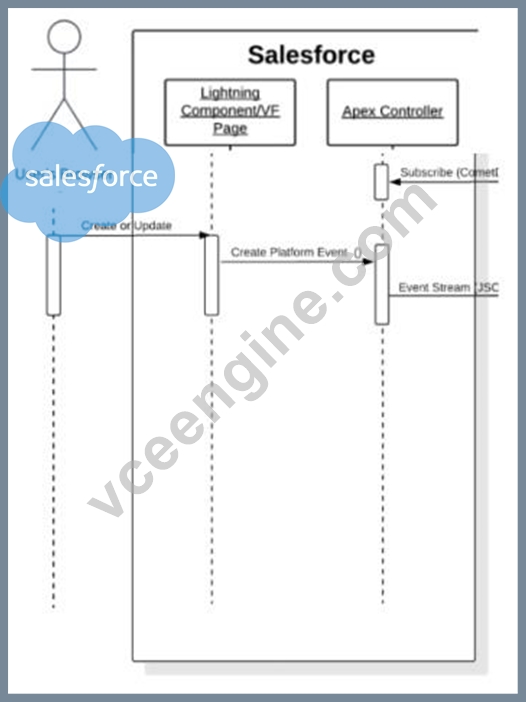
As part of its solution to accelerate overall sales. Universal Containers (UC) has chosen to implement a CPQ solution using Salesforce CPQ. As part of the CPQ solution, there is a requirement to retain UC's ERP as the Pricing and Product master.
UC's business process results in Products and Pricing being updated sporadically once a week, and then on a much larger scale on a monthly basis, which could result in a large amount of records that need to be updated in Salesforce.
Which strategy should the Solution Architect choose to handle this scenario?
- A. Option D, utilizing an external ETL tool to batch load the records into Salesforce
- B. Option B, utilizing Process Builder and Platform Events to communicate with the external services Subscriber Listener
- C. Option C, utilizing a VF/Lightning component in combination with an Apex Controller to make a call utilizing the Streaming API
- D. Option A, utilizing a VF/Lightning component in combination with an Apex Controller to make a REST call to the external service
Answer: A
Explanation:
Salesforce CPQ is an extension of the Salesforce CRM that automates the generation and processing of quotes, orders, and contracts. It enables your sales team to create quotes quickly and with minimal errors and efforts.
Salesforce CPQ can be integrated with ERP systems by converting Salesforce CPQ lead-to-order data into transactional data. This allows ERP systems to take over matching data and use it for accounting functions.
an external ETL tool can be used to batch load the records into Salesforce from the ERP system. This can handle large amounts of records that need to be updated sporadically or on a monthly basis.
https://www.rapidionline.com/blog/salesforce-cpq-data-integration-increase-sales
https://www.salesforce.com/products/cpq/resources/what-is-salesforce-cpq/
NEW QUESTION # 69
AC Computers is hitting governor limits when trying to create orders and activate orders in Salesforce. Upon further investigation, it's discovered that AC Computers is trying to process hundreds of order products on a single order. The Order object also has various automation processes to update fields and integrate with a third-party order management system.
What is one solution a Solution Architect should evaluate first to resolve this issue?
- A. Enable Advanced Order Management to process large orders.
- B. Install a third-party solution to process large orders.
- C. Create a custom object to hold orders in queue for processing.
- D. Review to determine if moving automation to asynchronous Apex is required.
Answer: D
Explanation:
Option B is a solution that can help AC Computers avoid hitting governor limits when processing large orders because asynchronous Apex can run in a separate thread and use higher limits than synchronous Apex1. For example, asynchronous Apex can process up to 50 million records per transaction, while synchronous Apex can only process up to 50 thousand records per transaction2. By moving some of their automation processes to asynchronous Apex, AC Computers can reduce the load on their Salesforce environment and improve performance.
A Solution Architect should evaluate moving automation to asynchronous Apex to resolve the issue of hitting governor limits when trying to create and activate orders in Salesforce. By moving the automation to asynchronous Apex, the automation processes can be run in a separate thread and will not affect the transaction limit for the current thread. This will prevent governor limits from being hit and ensure that the order creation and activation processes can be completed successfully.
NEW QUESTION # 70
......
Certification Training for B2B-Solution-Architect Exam Dumps Test Engine: https://torrentpdf.vceengine.com/B2B-Solution-Architect-vce-test-engine.html
