

Use Oracle 1z0-1065-25 Dumps To Succeed Instantly in 1z0-1065-25 Exam
Ultimate Guide to 1z0-1065-25 Dumps - Enhance Your Future Career Now
NEW QUESTION # 44
Challenge 7
Manage Qualification Areas
Scenario
Your procurement organization needs to group and organize qualification questions into a hierarchical structure.
Task
Create an active Qualification Area to hold the qualification question created previously, where:
. Name of the area is PRCXX Area 1 (Replace xx with 01, which is your allocated User ID.)
. Description references company history
. Owning procurement BU is US1 Business Unit
Expiration period is 10 days
. Questions and outcomes contain three options: Excellent, Average, Poor
Answer:
Explanation:
See below in Explanation for each Step.
Explanation:
Task 7: Create a Qualification Area for Supplier Questions
Following the scenario, we need to create a new Qualification Area in Oracle Procurement Cloud named
"PRCXX Area 1" (replace xx with 01) to organize the previously created supplier question.
Here are the steps to create the Qualification Area:
* Navigate to Manage Qualification Areas:
* Go to the Global Navigation Menu.
* Click on Procurement.
* Click on Setup and Maintenance.
* Click on Supplier Qualification.
* Click on Areas.
* Create the Qualification Area:
* Click on the Create icon (+ icon).
* Enter the Qualification Area Information:
* Name: Enter "PRCXX Area 1" (replace xx with 01).
* Description: Enter a brief description, such as "Company History and Experience".
* Owning Procurement BU: Select "US1 Business Unit".
* Expiration Period: Enter "10" in the Days field. This defines how long a supplier's responses will be valid before requiring re-evaluation.
* Default Qualification Owner: (Optional) Select a user who will be automatically assigned as the owner for newly created qualifications associated with this area.
* Active: Select "Yes" to activate the area.
* Add Qualification Questions:
* Click on the Questions and Outcomes icon.
* Select the previously created supplier question "PRCXX Q1" (replace xx with 01).
* Click on the Add icon (+ icon) to add it to the area.
* Define Outcomes:
* Click on the Outcomes tab.
* Click on the Create icon (+ icon) to define possible outcomes for the area.
* Enter three outcome options:
* Excellent
* Average
* Poor
* Assign a score or weight to each outcome if desired.
* Save the Qualification Area:
* Click on the Save button.
Verification:
* The Qualification Area "PRCXX Area 1" (replace xx with 01) should now be listed in the Manage Qualification Areas page.
* You can verify the area details, description, and associated supplier question by clicking on it.
* The owning procurement BU, expiration period, default owner, active status, and defined outcomes should be displayed as specified above.
Additional Notes:
* Make sure to replace "xx" with your allocated User ID (01) in the area name for consistent naming convention.
* The expiration period determines how often suppliers need to update their information for this area.
* Adding a default qualification owner simplifies the assignment process for new qualifications.
* Defining outcomes allows you to evaluate the responses to the qualification questions and assign scores or weights based on their performance.
NEW QUESTION # 45
You created a sourcing two-stage sealed Request For Quotation (RFQ) and invited five suppliers to participate. The Technical stage is completed and the Commercial stage is unlocked. At this time, in the Award Negotiation section > Award Line, you can see only three suppliers' responses as Active responses. You cannot see the other two suppliers' data in the Active responses.
What are two reasons for this?
- A. Suppliers were not shortlisted in the Technical stage.
- B. You entered these two suppliers' responses as surrogate responses by a buyer. In the Commercial stage, the buyer has not yet entered surrogate responses.
- C. Supplier responses are closed.
- D. Suppliers entered responses and because the RFQ is sealed, you cannot view these two suppliers' data.
Answer: A,B
NEW QUESTION # 46
Procurement Contracts allows you to take control of your contract lifecycle, from authoring and negotiation through implementation, enforcement, evaluation, and closeout. Procurement experts can quickly author contracts that comply with corporate standards.
Which statement applies to Procurement Contracts?
- A. Contracts may be amended post approval.
- B. Approved contracts may not be amended.
- C. Digital signatures must be added.
- D. Contract authoring may only be accessed from Procurement Contracts.
Answer: A
NEW QUESTION # 47
Challenge 4
Manage Inventory Organizations
Scenario:
Your procurement organization requires you to create an inventory organization, which will be used for issuing and receiving procurement transactions.
Task:
Create an Inventory Organization to receive procurement transactions, where:
. Name of the organization is PRCXX Organization (Replace xx with 01, which is your allocated User ID.)
. Organization code is PRCXXORG (Replace xx with 01, which is your allocated User ID.)
. Organization is linked to US1 Business Unit, US1 Legal Entity, and Redwood City - CA location
. Item Master Organization is linked to Operations
. Item Grouping Behavior is set to Definition Organization
. Schedule is set to Operations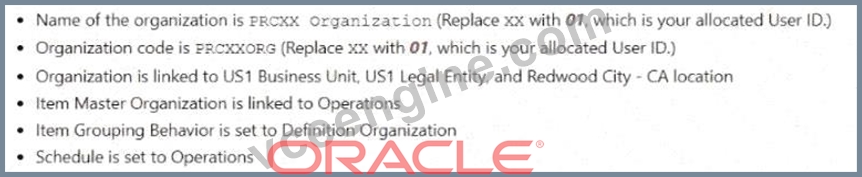
Answer:
Explanation:
See below in Explanation for each Step.
Explanation:
To create an Inventory Organization to receive procurement transactions, you can follow these steps:
* Navigate to the Setup and Maintenance work area and search for the Manage Inventory Organizations task.
* Click on the Go to Task icon to open the Manage Inventory Organizations page.
* Click on the Create icon to create a new inventory organization.
* Enter the following information in the Create Inventory Organization dialog box:
* Name: PRC01 Organization
* Code: PRC01ORG
* Business Unit: US1
* Legal Entity: US1
* Location: Redwood City - CA
* Item Master Organization: Operations
* Item Grouping Behavior: Definition Organization
* Schedule: Operations
* Click on the Save and Close button to save the inventory organization.
You have successfully created an inventory organization to receive procurement transactions. You can verify the inventory organization details by searching for it in the Manage Inventory Organizations page. For more information on how to create and manage inventory organizations, you can refer to the Inventory Organizations document.
Or use the following steps:
Following the scenario, we need to create a new Inventory Organization in Oracle Procurement Cloud named
"PRCXX Organization" (replace xx with 01) to receive procurement transactions.
Here are the steps to create the Inventory Organization:
* Navigate to Manage Inventory Organizations:
* Go to the Global Navigation Menu.
* Click on Supply Chain.
* Click on Setup and Maintenance.
* Click on Inventory Organizations.
* Create the Inventory Organization:
* Click on the Create icon (+ icon).
* Enter the Inventory Organization Information:
* Name: Enter "PRCXX Organization" (replace xx with 01).
* Organization Code: Enter "PRCXXORG" (replace xx with 01).
* Business Unit: Select "US1 Business Unit".
* Legal Entity: Select "US1 Legal Entity".
* Location: Select "Redwood City - CA".
* Item Master Organization: Select "Operations".
* Item Grouping Behavior: Select "Definition Organization".
* Schedule: Select "Operations".
* Description: (Optional) Enter a brief description of the inventory organization.
* Define Item Sourcing Details:
* Click on the Item Sourcing Details tab.
* Click on the Create icon (+ icon).
* Enter the item sourcing details for your organization, including:
* Picking Defaults
* Inventory Lead Time
* Supply Subinventory
* Shipping Rules
* Click on the Save and Close button.
* Save the Inventory Organization:
* Click on the Save button.
Verification:
* The Inventory Organization "PRCXX Organization" (replace xx with 01) should now be listed in the Manage Inventory Organizations page.
* You can verify the details of the organization by clicking on it.
* The linked Business Unit, Legal Entity, Location, Item Master Organization, Item Grouping Behavior, and Schedule should be displayed as specified above.
* Additionally, the Item Sourcing Details should reflect the defined values for picking, lead time, subinventory, and shipping rules.
Additional Notes:
* Make sure to replace "xx" with your allocated User ID (01) in both the Inventory Organization name and code for consistent naming convention.
* The Item Master Organization defines the organization responsible for managing item information.
* The Item Grouping Behavior determines how items are grouped for inventory purposes.
* The Schedule defines the calendar used for scheduling inventory transactions.
* Carefully review and configure the Item Sourcing Details to ensure proper receipt and fulfillment of procurement transactions within your organization.
NEW QUESTION # 48
Challenge 2
Manage Business Unit
Scenario:
Your organization needs to establish a business unit to manage its procurement activities and assign it to the newly created purchasing location in Redwood City, CA.
Task 2
Create a new Business Unit for your purchasing organization, where you need to:
. Name the business unit as PRCXX Business Unit (Replace xx with 01, which is your allocated User ID.)
. Assign the location previously created
. Link to the USLOCS default set
Answer:
Explanation:
See below in Explanation for each Step.
Explanation:
To create a new Business Unit for your purchasing organization, you can follow these steps:
* Navigate to the Setup and Maintenance work area and search for the Manage Business Unit task.
* Click on the Go to Task icon to open the Manage Business Unit page.
* Click on the Create icon to create a new business unit.
* Enter the following information in the Create Business Unit dialog box:
* Name: PRC01 Business Unit
* Location: PRC01 Location
* Default Set: USLOCS
* Click on the Save and Close button to save the business unit.
You have successfully created a new business unit for your purchasing organization. You can verify the business unit details by searching for it in the Manage Business Unit page.
Or use the following Steps:
Following the scenario, we need to create a new Business Unit in Oracle Procurement Cloud for your purchasing organization and assign the previously created location in Redwood City, CA.
Here are the steps to create the Business Unit:
* Navigate to Manage Business Units:
* Go to the Global Navigation Menu.
* Click on Setup and Maintenance.
* Click on Business Units under Common Tasks.
* Create the Business Unit:
* Click on the Create icon (+ icon).
* Enter the Business Unit Information:
* Name: Enter "PRCXX Business Unit" (replace xx with 01).
* Default Location: Select "PRCXX Location" (replace xx with 01) from the dropdown list.
* Default Set: Select "USLOCS" from the dropdown list.
* Description: (Optional) Enter a brief description of the business unit.
* Save the Business Unit:
* Click on the Save button.
Verification:
* The Business Unit "PRCXX Business Unit" (replace xx with 01) should now be listed in the Manage Business Units page.
* You can verify the details of the business unit by clicking on it.
* The default location and set should be displayed as "PRCXX Location" (replace xx with 01) and
"USLOCS," respectively.
Additional Notes:
* Make sure to replace "xx" with your allocated User ID (01) in both the Business Unit name and code for consistent naming convention.
* Assigning the US Location Set to the Business Unit ensures that it inherits the legal entities, accounts, and other context information from that set.
NEW QUESTION # 49
Your client's business requires that only Requester A is provided access to the punchout catalog and not Requester B.
Which configuration fulfills this requirement?
- A. Set the punchout catalog content zone security to "Secured by worker" with the value Requester A and no setup for Requester B.
- B. Set the punchout catalog security on the Punchout Catalog Definition page to "Secured by worker" with the value Requester A and no setup for Requester B.
- C. Assign the Advanced Procurement Requester role to Requester A and the Procurement Requester role to Requester B.
- D. Assign the Punchout Catalog Requester role to Procurement Requester A and the Procurement Requester role to Requester B.
Answer: A
NEW QUESTION # 50
When responding to a negotiation, the supplier can see their response amount and also a transformed amount in the negotiation.
What is added to the response amount to calculate the transformed amount?
- A. Internal cost factors
- B. External cost factors
- C. Attribute cost factors
- D. Fixed cost factors
- E. Variable cost factors
Answer: A
NEW QUESTION # 51
The Payables department has reported that a supplier does not appear in Submit Payment Process Request. The payment method selected from the payment processing options for Submit Payment Process Request is Electronic.
What are two reasons why the supplier does not appear?
- A. The supplier must have a Blanket Purchase Agreement in place.
- B. The From Date field value for the Electronic payment method is a future date.
- C. The Electronic payment method is end-dated on the Payment Method tab of the supplier profile for the supplier.
- D. The supplier has a default payment method of Check.
- E. The supplier does not have an active Purchase Order.
Answer: B,C
NEW QUESTION # 52
Your customer is importing supplier data into the application and wants to be able to create supplier content map sets to support the import.
Which three values can be included in the map set?
- A. Item
- B. Category
- C. Supplier
- D. Catalog
- E. UOM
Answer: B,C,E
NEW QUESTION # 53
During your implementation discussions, your client wants to use the procurement offering to create negotiations and make best-value award decisions. They also wish to be able to monitor their supplier's performance regularly to confirm that they are supplying consistent quality of materials, components and services in compliance with regulatory requirements.
Which functional areas would you use to achieve this?
- A. Sourcing, Supplier Qualification
- B. Sourcing, Supplier Qualification, and Purchasing
- C. Sourcing, Supplier Qualification, and Procurement Contracts
- D. Sourcing, Supplier Qualification, and Procurement Foundation
- E. Sourcing, Supplier Qualification, and Negotiations
Answer: E
NEW QUESTION # 54
In relation to suppliers, your client has several suppliers with whom they expect to do a high volume of business over an extender period. To simplify this, it would be useful to use master contracts to set the overall terms and conditions between parties.
Which two purchasing documents can link to this type of contract?
- A. Agreements
- B. Initiatives
- C. Negotiations
- D. Requisitions
- E. Purchase Orders
Answer: A,E
NEW QUESTION # 55
When setting up the supplier profile, you want to be able capture multiple certificates belonging to the same business classification that were issued by different certifying agencies. These should include the Certifying Agency, Certificate, Start Date, and Expiration Date as well as attachments and notes.
Which three are application-supplier standard business classification lookup values?
- A. Minority Owned
- B. Green Business
- C. Nonprofit Business
- D. Hub Zone
- E. Small Business
- F. ISO 14001
Answer: A,D,E
NEW QUESTION # 56
Your customer requires a consignment order to be automatically created whenever a self-service Requester creates a purchase requisition.
How do you set this up?
- A. Assign all the requisition lines to the consignment buyer.
- B. Select the "Source from consignment" check box and set Urgent to 'Yes'* during requisition creation through self-service.
- C. Enable all the requisition line items to be sourced from the consignment source.
- D. Create a consignment agreement with touchless buying options enabled on the Controls tab to automatically generate orders.
Answer: D
Explanation:
A consignment agreement is a type of purchasing document that defines the terms and conditions for consignment purchases. Consignment purchases are purchases of goods that are paid for only after the goods are used or sold by the purchasing organization. To enable automatic creation of consignment orders from requisitions, you need to create a consignment agreement with touchless buying options enabled on the Controls tab. Touchless buying options allow you to specify the criteria for automatically generating orders from requisitions without human intervention. You can also define the default attributes and processing options for the orders, such as document style, change order tolerance, and communication method.
References:
How can I create a purchase order for consignment inventory items?1
Create and Monitor Agreements in Oracle Fusion Purchasing2
NEW QUESTION # 57
The Procurement Catalog Administrator can map content received from a supplier to internal values used by the application.
For which three areas can they create map sets so that they may be converted to values in the Procurement business unit?
- A. UOM
- B. Catalog
- C. Category
- D. Supplier
- E. Sourcing
Answer: B,C,D
NEW QUESTION # 58
During the implementation, several policies regarding mobile phones, purchasing laptops, and travel have been created and assigned to a category for browsing, but they are not being shown in purchase requisitions.
Where should they be added to ensure they are displayed on the shopping page?
- A. Content Zone
- B. Requisitioning Business Unit
- C. Smart Form
- D. Procurement Business Unit
- E. Punchout Catalog
Answer: A
NEW QUESTION # 59
You are implementing Payables and Procurement and are ready to set up business units.
Which three common controls and default values need to be set?
- A. Collaborating Messaging
- B. Automatic Offsets
- C. Currency Conversion
- D. Expense Accruals
- E. Buyer Assignments
Answer: B,D,E
NEW QUESTION # 60
Your client wants to be able to automate the process to ask employees to evaluate their suppliers periodically and enable a touchless process to track supplier performance over time.
Which feature do they need to opt in to?
- A. Assess Supplier Eligibility for Sourcing
- B. Sourcing Programs
- C. Conduct Internal Surveys for Supplier Qualification
- D. Full Supplier Profile Change Management
Answer: C
Explanation:
The feature that enables the automation of supplier evaluation by employees is Conduct Internal Surveys for Supplier Qualification. This feature allows you to create and publish internal surveys to collect feedback from employees who have interacted with suppliers. You can use predefined or custom questions, assign survey respondents, and schedule survey frequency. The survey responses are automatically captured and aggregated in the supplier qualification work area, where you can view the supplier performance scores and trends over time. This feature helps you to monitor and improve supplier performance, as well as identify potential risks and opportunities.
:
Conduct Internal Surveys for Supplier Qualification
How You Conduct Internal Surveys for Supplier Qualification
Oracle Fusion Cloud Procurement: Supplier Qualification
NEW QUESTION # 61
In relation to Supplier Business Classification lookups, many standard lookup values are provided by the application. These application-supplied standard business classifications are displayed by default in the FBDi Supplier Business Classifications Import template.
Which three are application-supplied standard business classifications?
- A. ISO14001
- B. Green Business
- C. Nonprofit Business
- D. Hub Zone
- E. Small Business
- F. Minority Owned
Answer: D,E
NEW QUESTION # 62
You want to send your purchasing documents from a specific organization email address, Which task would you use to set this up?
- A. Manage Purchasing Messages
- B. Manage Purchasing Profile Messaging options
- C. Manage Purchasing value sets
- D. Manage Purchasing application core messages
- E. Manage Purchasing profile options
Answer: E
NEW QUESTION # 63
Challenge 3
Manage Purchasing Line Types
Scenario:
Your business unit requires a new line type for purchasing transactions.
Task3:
Create a new Purchasing Line Type, where:
. Name of the line type is PRCXX Computer Goods (Replace xx with 01, which is your allocated User ID.)
Code is PRCXXCOMP
. Purchase basis is quantity-based for the Goods product type
. Line type is linked to the Computer Supplies category
. Unit is Ea
Answer:
Explanation:
See below in Explanation for each Step.
Explanation:
To create a new Purchasing Line Type, you can follow these steps:
* Navigate to the Setup and Maintenance work area and search for the Manage Purchasing Line Types task.
* Click on the Go to Task icon to open the Manage Purchasing Line Types page.
* Click on the Create icon to create a new line type.
* Enter the following information in the Create Line Type dialog box:
* Name: PRC01 Computer Goods
* Code: PRC01COMP
* Purchase Basis: Quantity
* Product Type: Goods
* Category: Computer Supplies
* Unit of Measure: Ea
* Click on the Save and Close button to save the line type.
You have successfully created a new Purchasing Line Type. You can verify the line type details by searching for it in the Manage Purchasing Line Types page. For more information on how to define and use line types, you can refer to the Defining Line Types (Oracle Purchasing Help) document.
Or use the following:
Following the scenario, we need to create a new Purchasing Line Type in Oracle Procurement Cloud named
"PRCXX Computer Goods" (replace xx with 01) for purchasing computer supplies.
Here are the steps to create the Purchasing Line Type:
* Navigate to Manage Purchasing Line Types:
* Go to the Global Navigation Menu.
* Click on Procurement.
* Click on Setup and Maintenance.
* Click on Purchasing Line Types.
* Create the Purchasing Line Type:
* Click on the Create icon (+ icon).
* Enter the Purchasing Line Type Information:
* Name: Enter "PRCXX Computer Goods" (replace xx with 01).
* Code: Enter "PRCXXCOMP".
* Purchase Basis: Select "Quantity-Based".
* Product Type: Select "Goods".
* Category: Select "Computer Supplies".
* Unit: Enter "Ea" (for Each).
* Description: (Optional) Enter a brief description of the line type.
* Map Accounts:
* Click on the Map Accounts tab.
* Select the appropriate accounts for the following:
* Inventory Asset Account
* Inventory Expense Account
* Cost of Goods Sold Account
* Click on the Save and Close button.
* Save the Purchasing Line Type:
* Click on the Save button.
Verification:
* The Purchasing Line Type "PRCXX Computer Goods" (replace xx with 01) should now be listed in the Manage Purchasing Line Types page.
* You can verify the details of the line type by clicking on it.
* The purchase basis, product type, category, unit, and mapped accounts should be displayed as specified above.
Additional Notes:
* Make sure to replace "xx" with your allocated User ID (01) in both the Purchasing Line Type name and code for consistent naming convention.
* Mapped accounts define where the financial transactions associated with this line type will be posted in the General Ledger.
* Carefully review the mapped accounts to ensure they are aligned with your organization's accounting practices.
NEW QUESTION # 64
When creating a negotiation, the category manager wants to send it to all supplier contacts for a supplier.
Which is the most efficient way to achieve this?
- A. Create a negotiation and send it to the supplier bidder contact for forward distribution.
- B. Create the negotiation by using a negotiation style with the appropriate supplier control selected.
- C. Create a negotiation by using a negotiation template with each supplier contact added.
- D. Create a negotiation and add each supplier contact to it.
Answer: B
Explanation:
The most efficient way to send a negotiation to all supplier contacts for a supplier is to use a negotiation style that has the supplier control option of "All supplier contacts" enabled. This option allows you to automatically include all the contacts associated with a supplier when you add the supplier to the negotiation. You do not need to manually add each contact or rely on the supplier bidder contact to forward the negotiation. You can also create a negotiation template with this option enabled and use it to create a negotiation.
:
Examples of Negotiation Controls, Section 1: "Examples of Negotiation Controls", Subsection: "Supplier Controls" Create Supplier Negotiations from Template, Section 1: "Create Supplier Negotiations from Template"
NEW QUESTION # 65
You want to process negotiations with hundreds of lines.
Which two options in Sourcing enable you to process large negotiations?
- A. Invite additional suppliers post publish
- B. Award lines spreadsheet
- C. file-based data import (FBDI)
- D. Integration with Purchasing to generate purchasing documents
- E. Proxy-bidding
Answer: B,C
Explanation:
To process negotiations with hundreds of lines, you can use the file-based data import (FBDI) and the award lines spreadsheet options in Sourcing. The FBDI option allows you to import a large number of negotiation lines using a MS Excel template and a background process. You can also update or delete existing lines using the same option. The award lines spreadsheet option allows you to export the negotiation lines to a MS Excel file, where you can enter the award decisions and amounts. You can then import the file back to the application using a background process to complete the award.
:
How You Create Large Negotiations, Section 1: "How You Create Large Negotiations" Award Negotiations Using Spreadsheet, Section 1: "Award Negotiations Using Spreadsheet"
NEW QUESTION # 66
In Sourcing, on which option is the ranking based when you set Overall Ranking Method to "Composite scoring"?
- A. Assess suppliers on both pricing and external cost factors.
- B. Assess suppliers on both pricing and supplier eligibility.
- C. Assess suppliers on both pricing and internal cost factors.
- D. Assess suppliers on both pricing and qualitative aspects.
Answer: D
Explanation:
When you set the Overall Ranking Method to Composite scoring, you can assess suppliers on both pricing and qualitative aspects. Qualitative aspects include requirements such as technical capabilities, other commercial considerations, or risk. You can assign weights to requirement sections, including pricing, and calculate a composite score for each supplier based on their response amount and requirement scores. The composite score is a combination of the relative score for pricing and the weighted requirement score. The higher the composite score, the higher the overall rank. This way, you can rank suppliers not just based on the best pricing offered, but also on how well they meet your requirements.
References:
Rank Suppliers Based on Composite Score of Pricing and Requirements1
Oracle Supplier Negotiations2
NEW QUESTION # 67
Your organization has its headquarters in India, and has three manufacturing facilities in Japan, Singapore, and Taiwan. The raw material requirements for these three manufacturing units are consolidated and procured from Japan.
How should you model this scenario in Oracle Fusion Cloud Procurement?
- A. Requisitioning Bus; India, Singapore, and Taiwan; Procurement BU: Japan
- B. Requisitioning Bus: India, Japan, and Taiwan; Procurement BU: India and Japan
- C. Requisitioning Bus; India, Japan, and Singapore; Procurement BU: Japan and Taiwan
- D. Requisitioning Bus: Japan, Singapore, and Taiwan; Procurement BU: Japan
Answer: D
NEW QUESTION # 68
Which method must you use to manage setup data if you need to modify default setup best practices and assign tasks to various users?
- A. Configure Basic Enterprise Structure
- B. Manage Implementation Projects
- C. Manage Offerings and Features
- D. Rapid Implementation Task List
Answer: B
NEW QUESTION # 69
......
Oracle Dumps - Learn How To Deal With The Exam Anxiety: https://torrentpdf.vceengine.com/1z0-1065-25-vce-test-engine.html
