

Updated Microsoft AZ-104 Dumps – Check Free AZ-104 Exam Dumps (2024)
Updated AZ-104 exam with Microsoft Real Exam Questions
The Microsoft AZ-104 exam is designed for professionals who have experience working with Azure technologies and services. It is ideal for IT professionals, system administrators, and developers who want to validate their knowledge and skills in Azure administration. Additionally, the exam is valuable for those seeking to enhance their career prospects and advance their professional development.
Microsoft AZ-104 Certification Exam has been updated to reflect the latest changes in Azure services. AZ-104 exam now covers topics such as Azure Active Directory, Azure Resource Manager, Azure Storage, Azure Virtual Machines, and Azure Networking. AZ-104 exam also includes hands-on labs that test the candidate's practical skills in administering Azure services.
In Conclusion
Moving from an entry to an associate level of expertise with the help of AZ-104 exam might be an enjoyable and exciting journey if you use the best study materials. In this case, you will pass the test easily and will get ready for any challenges in the workplace. And then, with the Microsoft Certified: Azure Administrator Associate, so many new doors will open for you!
NEW QUESTION # 95
You have an Azure Storage account named storage1 that contains a blob container. The blob container has a default access tier of Hot. Storage1 contains a container named container!
You create lifecycle management rules in storage1 as shown in the following table.
You perform the actions shown in the following table.
For each of the following statements, select Yes if the statement is true. Otherwise, select No. NOTE: Each correct selection is worth one point.
Answer:
Explanation:
Explanation
On October 10, you can read Dep1File1.docx. = NO
Explanation: Dep1File1.docx is a blob in container1 that was uploaded on October 1 and edited on October 2.
According to the lifecycle management rule 1, any blob in container1 that has not been modified for 7 days will be moved to the archive tier. Therefore, on October 9, Dep1File1.docx will be moved to the archive tier.
Blobs in the archive tier cannot be read unless they are first rehydrated, which may take several hours or days.
Therefore, on October 10, you cannot read Dep1File1.docx unless you rehydrate it first.
On October 10, you can read File2.docx. = YES
Explanation: File2.docx is a blob in container1 that was uploaded on October 1 and edited on October 5.
According to the lifecycle management rule 1, any blob in container1 that has not been modified for 7 days will be moved to the archive tier. Therefore, on October 12, File2.docx will be moved to the archive tier.
However, on October 10, File2.docx is still in the hot tier, which means it can be read without any delay or cost.
On October 10, you can read File3.docx. = NO
Explanation: File3.docx is a blob in container1 that was uploaded on October 1 and edited on October 2.
According to the lifecycle management rule 2, any blob in container1 that has not been modified for 5 days will be deleted. Therefore, on October 7, File3.docx will be deleted from the storage account. Therefore, on October 10, you cannot read File3.docx because it no longer exists.
NEW QUESTION # 96
Note: This question is part of a series of questions that present the same scenario. Each question in the series contains a unique solution that might meet the stated goals. Some question sets might have more than one correct solution, while others might not have a correct solution.
After you answer a question in this section, you will NOT be able to return to it. As a result, these questions will not appear in the review screen.
You manage a virtual network named VNet1 that is hosted in the West US Azure region.
VNet1 hosts two virtual machines named VM1 and VM2 that run Windows Server.
You need to inspect all the network traffic from VM1 to VM2 for a period of three hours.
Solution: From Azure Network Watcher, you create a connection monitor.
Does this meet the goal?
- A. No
- B. Yes
Answer: A
Explanation:
Network Watcher Connection Monitor enables you to configure and track connection reachability, latency, and network topology changes. It helps reduce the amount of time to detect connectivity problems. The returned results can provide insights into whether a connectivity problem is due to a platform or a user configuration problem. This is not used in cases where we need to inspect for all the network traffic from one vm to another vm.
On the other hand Network Watcher packet capture allows you to create capture sessions to track traffic to and from a virtual machine. So in this scenario we need to use Network Watcher packet capture References:
https://azure.microsoft.com/en-in/updates/general-availability-azure-network-watcher-connection-monitor-in-all-public-regions/#:~:text=Network%20Watcher%20Connection%20Monitor%20helps,or%20a%20user%20configuration%20problem
https://docs.microsoft.com/en-us/azure/network-watcher/network-watcher-packet-capture-manage-portal
NEW QUESTION # 97
You are evaluating the connectivity between the virtual machines after the planned implementation of the Azure networking infrastructure.
For each of the following statements, select Yes if the statement is true. Otherwise, select No.
Answer:
Explanation:
NEW QUESTION # 98
You have an Azure virtual machine that runs Windows Server 2019 and has the following configurations:
* Name: VM1
* Location: West US
* Connected to: VNET1
* Private IP address: 10.1.0.4
* Public IP address: 52.186.85.63
* DNS suffix in Windows Server: Adatum.com
You create the Azure DNS zones shown in the following table.
You need to identify which DNS zones you can link to VNET1 and the DNS zones to which VM1 can automatically register.
Which zones should you identify? To answer, select the appropriate options in the answer area.
Answer:
Explanation:
Explanation
Reference:
https://docs.microsoft.com/en-us/azure/dns/private-dns-overview
NEW QUESTION # 99
You need to implement Role1.
Which command should you run before you create Role1? To answer, select the appropriate options in the answer area.
NOTE: Each correct selection is worth one point.
Answer:
Explanation:
NEW QUESTION # 100
You have an Azure subscription named Subscription1 that contains the resources in the following table.
You install the Web Server server role (IIS) on WM1 and VM2, and then add VM1 and VM2 to LB1.
LB1 is configured as shown in the LB1 exhibit. (Click the Exhibit button.)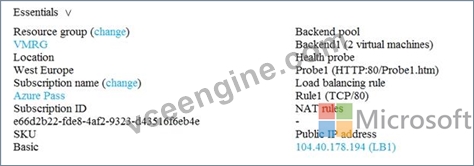
Rule1 is configured as shown in the Rule1 exhibit. (Click the Exhibit button.)
For each of the following statements, select Yes if the statement is true. Otherwise, select No.
NOTE: Each correct selection is worth one point.
Answer:
Explanation:
Reference:
https://docs.microsoft.com/en-us/azure/load-balancer/skus
NEW QUESTION # 101
You have an on-premises network that includes a Microsoft SQL Server instance named SQL1.
You create an Azure Logic App named App1.
You need to ensure that App1 can query a database on SQL1.
Which three actions should you perform in sequence? To answer, move the appropriate actions from the list of actions to the answer area and arrange them in the correct order.
Answer:
Explanation:
1 - From an on-premises computer, install
2 - From the Azure portal, create...
3 - From the Logic Apps Designer in...
Reference:
https://docs.microsoft.com/en-us/azure/logic-apps/logic-apps-gateway-connection
NEW QUESTION # 102
You have an Azure subscription that contains the resource groups shown in the following table.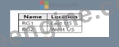
You create the following Azure Resource Manager (ARM) template named deploy json.
You deploy the template by running the following cmdlet.
Item-AzSubscriptionDeployment -location -Template file deploy-json For each or the following statements, select Yes il the statement is bue. Otherwise, select No.
NOTE: Each correct selection is worth one point.
Answer:
Explanation:
Explanation
NEW QUESTION # 103
You have an Azure subscription. The subscription contains virtual machines that run Windows Server 2016 and are configured as shown in the following table.
You create a public Azure DNS zone named adatum.com and a private Azure DNS zone named conioso.com.
You create a virtual network link for contoso.com as shown in the following exhibit.
For each of the following statements, select Yes if the statement is true. Otherwise, select No.
NOTE: Each correct selection is worth one point.
Answer:
Explanation:
NEW QUESTION # 104
You have an Azure Storage account named storage1.
You have an Azure App Service app named app1 and an app named App2 that runs in an Azure container instance. Each app uses a managed identity.
You need to ensure that App1 and App2 can read blobs from storage1 for the next 30 days.
What should you configure in storage1 for each app?
Answer:
Explanation:
Explanation:
With Shared access signature you can limit the resources for access and at the same time can control the duration of the access.
A shared access signature (SAS) provides secure delegated access to resources in your storage account without compromising the security of your data. With a SAS, you have granular control over how a client can access your data. You can control what resources the client may access, what permissions they have on those resources, and how long the SAS is valid, among other parameters.
Reference:
https://docs.microsoft.com/en-us/azure/storage/common/storage-sas-overview
NEW QUESTION # 105
You have an Azure Active Directory (Azure AD) tenant that has the initial domain name.
You have a domain name of contoso.com registered at a third-party registrar.
You need to ensure that you can create Azure AD users that have names containing a suffix of @contoso.com.
Which three actions should you perform in sequence? To answer, move the appropriate cmdlets from the list of cmdlets to the answer area and arrange them in the correct order.
Answer:
Explanation:
1 - Add a custom domian name.
2 - Add a record to the public contoso.com DNS zone.
3 - Verify the domain.
NEW QUESTION # 106
You have an Azure Active Directory tenant named Contoso.com that includes following users:
Contoso.com includes following Windows 10 devices:
You create following security groups in Contoso.com:
For each of the following statements, select Yes if the statement is true. Otherwise, select No.
NOTE: Each correct selection is worth one point.
Answer:
Explanation:
Explanation
Box 1: Yes
User1 is a Cloud Device Administrator.
Device2 is Azure AD joined.
Group1 has the assigned to join type. User1 is the owner of Group1.
Note: Assigned groups - Manually add users or devices into a static group.
Azure AD joined or hybrid Azure AD joined devices utilize an organizational account in Azure AD Box 2: No User2 is a User Administrator.
Device1 is Azure AD registered.
Group1 has the assigned join type, and the owner is User1.
Note: Azure AD registered devices utilize an account managed by the end user, this account is either a Microsoft account or another locally managed credential.
Box 3: Yes
User2 is a User Administrator.
Device2 is Azure AD joined.
Group2 has the Dynamic Device join type, and the owner is User2.
References:
https://docs.microsoft.com/en-us/azure/active-directory/devices/overview
NEW QUESTION # 107
You deploy an Azure Kubernetes Service (AKS) cluster that has the network profile shown in the following exhibit.
Use the drop-down menus to select the answer choice that completes each statement based on the information presented in the graphic. NOTE: Each correct selection is worth one point.
Answer:
Explanation:
Reference:
https://docs.microsoft.com/en-us/azure/aks/configure-azure-cni
NEW QUESTION # 108
You have an Azure subscription named Subscroption1.
In Subscription1, you create an alert rule named Alert1.
The Alert1 action group is configured as shown in the following exhibit.
Alert1 alert criteria is triggered every minute.
Use the drop-down menus to select the answer choice that completes each statement based on the information presented in the graphic.
NOTE: Each correct selection is worth one point.
Answer:
Explanation:
Reference:
https://github.com/MicrosoftDocs/azure-docs/blob/master/articles/monitoring-and-diagnostics/monitoring-overview-alerts.md
NEW QUESTION # 109
You have the Azure virtual machines shown in the following table.
You have a Recovery Services vault that protects VM1 and VM2.
You need to protect VM3 and VM4 by using Recovery Services.
What should you do first?
- A. Create a new Recovery Services vault.
- B. Configure the extensions for VM3 and VM4.
- C. Create a new backup policy.
- D. Create a storage account.
Answer: A
NEW QUESTION # 110
You have an Azure subscription that contains the resources shown in the following table.
You plan to create a data collection rule named DCRI in Azure Monitor.
Which resources can you set as data sources in DCRI, and which resources can you set as destinations in DCRI? To answer, select the appropriate options in the answer are a.
NOTE: Each correct selection is worth one point.
Answer:
Explanation:
NEW QUESTION # 111
You have an Azure virtual machine named VM1 that runs Windows Server 2019. You sign in to VM1 as a user named User 1 and perform the following actions:
* Create files on drive C.
* Create files on drive 0.
* Modify the screen saver timeout.
* Change the desktop background.
You plan to redeploy VM1.
Which changes will be lost after you redeploy VM1?
- A. The new files on drive C
- B. the modified screen saver timeout
- C. the new files on drive D
- D. the new desktop background
Answer: C
Explanation:
https://www.cloudelicious.net/azure-vms-and-their-temporary-storage/
https://docs.microsoft.com/en-us/azure/virtual-machines/troubleshooting/redeploy-to-new-node-windows#:~:text=Redeploy%20Windows%20virtual%20machine%20to%20new%20Azure%20node&text=When%20you%20redeploy%20a%20VM,configuration%20options%20and%20associated%20resources.
NEW QUESTION # 112
You have an Azure subscription named Subcription1 that contains a resource group named RG1.
In RG1. you create an internal load balancer named LB1 and a public load balancer named 162.
You need to ensure that an administrator named Admin 1 can manage LB1 and LB2. The solution must follow the principle of least privilege.
Which role should you assign to Admin1 for each task? To answer, select the appropriate options in the answer area.
NOTE: Caen correct selection is worth one point.
Answer:
Explanation:
Explanation
Box 1: Network Contributor on RG1
To add to the backend pool, write permission is required on the Resource Group because it writes deployment information. To add a backend pool, you need network contributor role on the LB and on the VMs that will be part of the backend pool.
For this reason the network contributor role must be assigned to the RG where the LB and the VM resides. So the correct answer is Network Contributor on RG1 .
Box 2: Network Contributor on RG1
For Health Probe also, without having access to RG1, no health probe can be added. If only Network Contributor role is assigned to LB then the user would not be able to access the IP addresses of the member pools.
Owner/Contributor can give the user access for everything. So it will not fit into the the principle of least privilege. Hence Owner and contributor role is incorrect choices for the question.
Reference:
https://docs.microsoft.com/en-us/azure/role-based-access-control/built-in-roles
NEW QUESTION # 113
You have an Azure Active Directory (Azure AD) tenant named adatum.com. Adatum.com contains the groups in the following table.
You create two user accounts that are configured as shown in the following table.
To which groups do User1 and User2 belong? To answer. select the appropriate options in the answer area.
NOTE: Each correct selection is worth one point.
Answer:
Explanation:
Explanation
Box 1: Group 1 only
First rule applies
Box 2: Group1 and Group2 only
Both membership rules apply.
References: https://docs.microsoft.com/en-us/sccm/core/clients/manage/collections/create-collections
NEW QUESTION # 114
Note: This question is part of a series of questions that present the same scenario. Each question in the series contains a unique solution that might meet the stated goals. Some question sets might have more than one correct solution, while others might not have a correct solution.
After you answer a question in this section, you will NOT be able to return to it. As a result, these questions will not appear in the review screen.
Your company has 100 users located in an office in Paris.
The on-premises network contains the servers shown in the following table.
You create a new subscription. You need to move all the servers to Azure.
Solution: You use the Data Migration Assistant tool.
Does this meet the goal?
- A. No
- B. Yes
Answer: A
Explanation:
The Data Migration Assistant tool is used to assess on-premises SQL Server instance(s) migrating to Azure SQL database(s).
Reference:
https://docs.microsoft.com/en-us/sql/dma/dma-overview?view=sql-server-ver15
NEW QUESTION # 115
You have peering configured as shown in the following exhibit.
Use the drop-down menus to select the answer choice that completes each statement based on the information presented in the graphic.
NOTE: Each correct selection is worth one point.
Answer:
Explanation:
Reference:
https://blog.kloud.com.au/2018/10/19/address-space-maintenance-with-vnet-peering/
https://docs.microsoft.com/en-us/azure/virtual-network/virtual-network-manage-peering#requirements-andconstraints
NEW QUESTION # 116
You have an Azure subscription named Subscription1. Subscription1 contains a virtual machine named VM1.
You install and configure a web server and a DNS server on VM1.
VM1 has the effective network security rules shown in the following exhibit.
Use the drop-down menus to select the answer choice that completes each statement based on the information presented in the graphic.
NOTE: Each correct selection is worth one point.
Answer:
Explanation:
References:
https://docs.microsoft.com/en-us/azure/virtual-network/security-overview
NEW QUESTION # 117
You need to configure the Device settings to meet the technical requirements and the user requirements.
Which two settings should you modify? To answer, select the appropriate settings in the answer area.
Answer:
Explanation:
Explanation

Box 1: Selected
Only selected users should be able to join devices
Box 2: Yes
Require Multi-Factor Auth to join devices.
From scenario:
* Ensure that only users who are part of a group named Pilot can join devices to Azure AD
* Ensure that when users join devices to Azure Active Directory (Azure AD), the users use a mobile phone to verify their identity.
NEW QUESTION # 118
You have an Azure subscription named Subscription1 that contains the following resource group:
Name: RG1
Region: West US
Tag: "tag1": "value1"
You assign an Azure policy named Policy1 to Subscription1 by using the following configurations:
Exclusions: None
Policy definition: Append tag and its default value
Assignment name: Policy1
Parameters:
- Tag name: Tag2
- Tag value: Value2
After Policy1 is assigned, you create a storage account that has the following configurations:
Name: storage1
Location: West US
Resource group: RG1
Tags: "tag3": "value3"
You need to identify which tags are assigned to each resource.
What should you identify? To answer, select the appropriate options in the answer area.
NOTE: Each correct selection is worth one point.
Answer:
Explanation:
Reference:
https://docs.microsoft.com/en-us/azure/azure-resource-manager/resource-group-using-tags
NEW QUESTION # 119
You create a virtual machine scale set named Scale1. Scale1 is configured as shown in the following exhibit.
Use the drop-down menus to select the answer choice that completes each statement based on the information presented in the graphic.
Answer:
Explanation:
Explanation:
Box 1:
The Autoscale scale out rule increases the number of VMs by 2 if the CPU threshold is 80% or higher. The initial instance count is 4 and rises to 6 when the 2 extra instances of VMs are added.
Box 2:
The Autoscale scale in rule decreases the number of VMs by 4 if the CPU threshold is 30% or lower. The initial instance count is 4 and thus cannot be reduced to 0 as the minimum instances is set to 2. Instances are only added when the CPU threshold reaches 80%.
References:
https://docs.microsoft.com/en-us/azure/azure-monitor/platform/autoscale-overview
https://docs.microsoft.com/en-us/azure/azure-monitor/platform/autoscale-best-practices
https://docs.microsoft.com/en-us/azure/azure-monitor/platform/autoscale-common-scale-patterns
NEW QUESTION # 120
......
Actual AZ-104 Exam Recently Updated Questions with Free Demo: https://torrentpdf.vceengine.com/AZ-104-vce-test-engine.html
